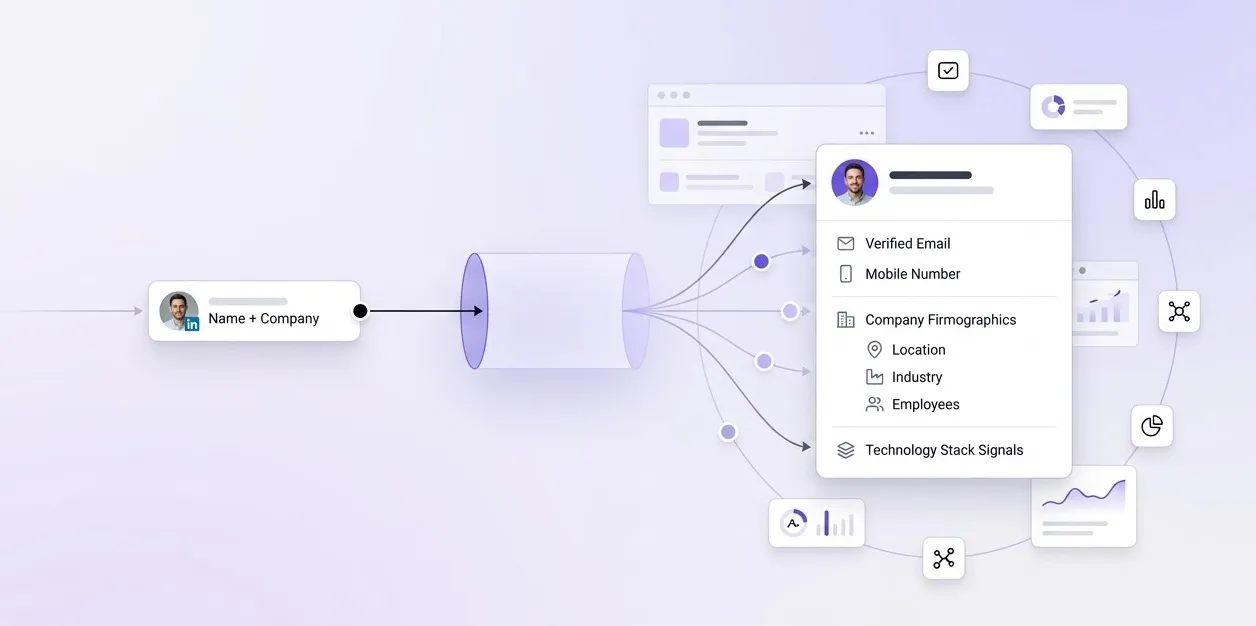

Sales lead enrichment takes a minimal identifier, typically a LinkedIn URL or a name plus company domain, and returns a verified buyer profile. The output is not just more fields in a CRM. It is actionable intelligence: direct contact data that connects, firmographic context that confirms ICP fit, technographic signals that shape positioning, and chronographic triggers that indicate when to act.
Most outbound failures are not effort problems. A rep dialing a disconnected number or emailing a contact who changed jobs six months ago is not underperforming because of bad technique. The data underneath their outreach is wrong.
What Is Sales Lead Enrichment?
Sales lead enrichment is the process of appending verified professional, organizational, and technical data to a contact or account record before outreach. A name and company domain becomes a complete buyer profile: current job title, direct mobile, company revenue, technology stack, and intent signals. It bridges the gap between a raw lead and an actionable prospect.
Where B2B data enrichment covers the full scope of organizational data, sales lead enrichment is output-oriented. Every appended data point has to justify itself through a direct improvement in outreach quality, conversion rate, or sales cycle speed. Enrichment that does not change rep behavior or campaign performance adds noise, not value.
A complete enrichment run tells a rep not just who to contact, but what to say, which channel to use, and when the prospect is most likely to respond.
What Data Does Sales Lead Enrichment Add?
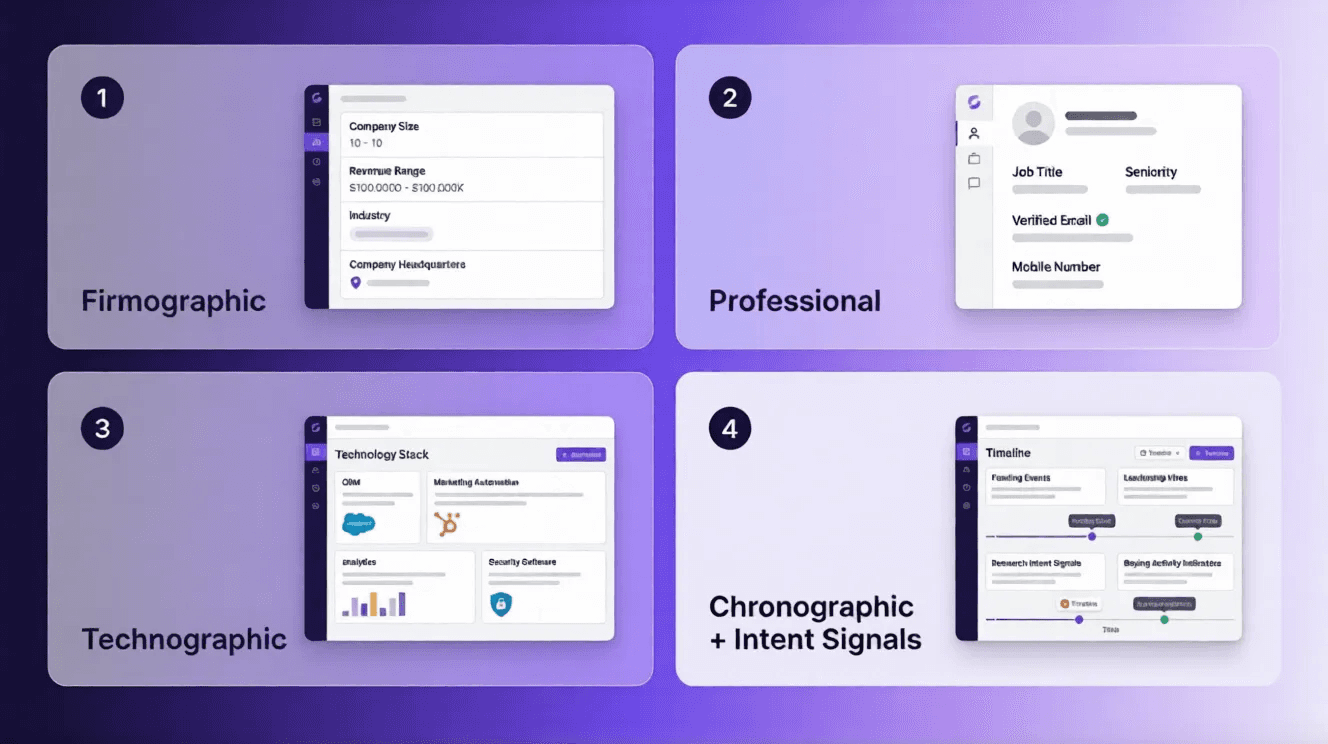
Sales lead enrichment draws on four data categories, each solving a different failure point in the outbound process. Together they convert a skeletal contact record into a working buyer profile. Pull any one of them and a specific part of the sales motion degrades.
Data Layer | What It Adds | Where It Drives Impact |
Firmographic | Company size, revenue, industry, HQ location, growth stage | ICP qualification, territory routing, deal sizing |
Professional | Job title, seniority, department, direct email, mobile phone | Outreach targeting, personalization, connect rates |
Technographic | Current tech stack: CRM, marketing automation, analytics, security | Positioning strategy, competitive displacement, integration sell |
Chronographic + Intent | Funding rounds, leadership hires, expansion signals, topic research | Outreach timing, trigger-based sequences, buying window identification |
Firmographic data establishes whether an account belongs in the pipeline at all. Company size determines whether the product fits the buying motion. Revenue range indicates budget availability. Industry shapes messaging. Without accurate firmographics, teams run campaigns at companies too small, too large, or structurally mismatched for the solution.
Professional data determines whether outreach actually connects. A job title without a verified direct email and mobile is a half-profile. Sales reps spend only 30% of their time actively selling, with the rest consumed by administrative tasks including manual data research. Enrichment shifts that balance by eliminating lookup work so reps spend time engaging, not searching.
Technographic data tells the rep what the prospect already runs. Selling project management software to an account on a direct competitor calls for a different message than selling to one running legacy spreadsheets. Each scenario is distinct. Without technographics, both situations look identical in the CRM.
Chronographic and intent signals answer the timing question. A funding announcement means new budget. A new VP of Sales hire opens a window before priorities lock. A company actively researching a product category across third-party publisher sites means a buying cycle is already open. Personalized outreach tied to relevant triggers sees 32% higher response rates than generic messaging. Intent data is what makes that personalization contextually relevant rather than cosmetic.
How Does Sales Lead Enrichment Work?
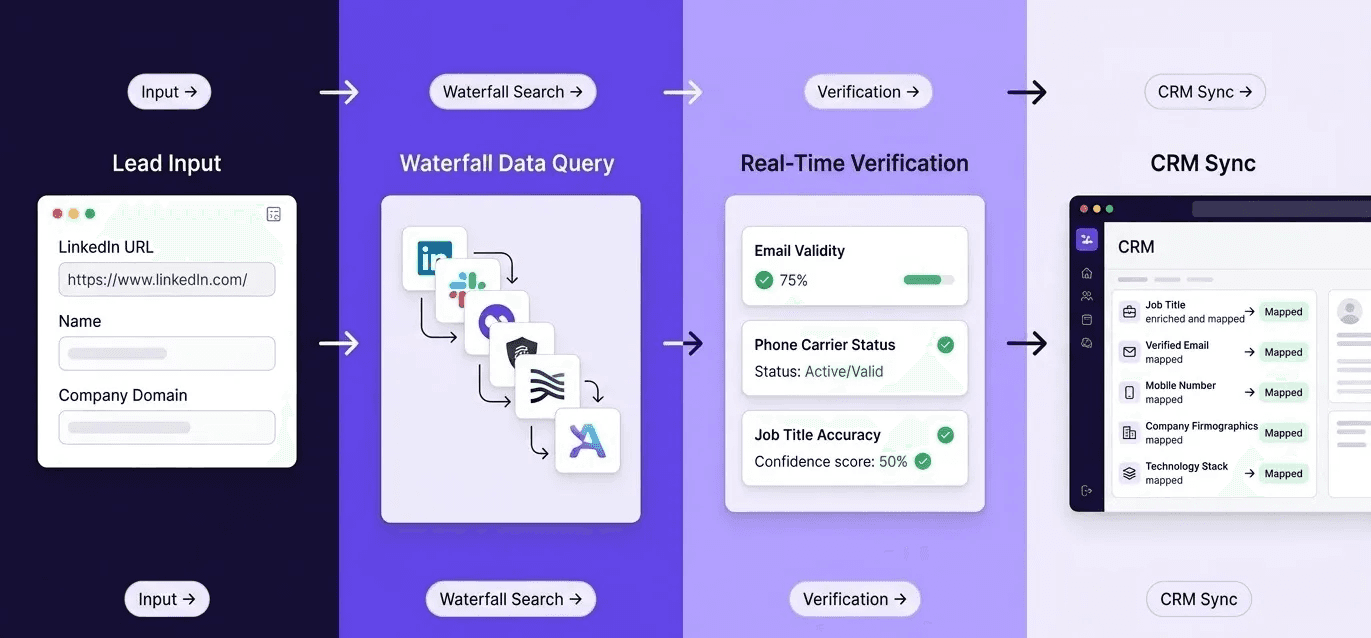
Sales lead enrichment runs through four sequential operations from input to verified output. The quality of each stage determines the usability of what comes out at the end. Skipping or shortcutting any step produces data that looks complete but behaves like it is not.
The initial query starts with identifiers already on the record: a company domain, a LinkedIn URL, a name plus company combination, or a work email. These anchor the search. A LinkedIn URL is more precise than a name alone. A corporate domain narrows the lookup in ways a personal email cannot.
Sequential waterfall querying is what separates modern enrichment from single-source tools. A single-provider platform returns whatever it has and stops. A waterfall system queries the first provider, notes what was found and what is still missing, then moves automatically to the second provider to fill the gaps. This continues across 20 or more sources until the record is complete or all sources are exhausted. The practical difference is match rate: single-source tools return results on 40 to 60% of submitted records, while waterfall enrichment consistently reaches 80% and above.
Real-time verification runs after the match. An email found across three providers is still not verified until an SMTP handshake confirms the inbox is active and accepting mail. A mobile number is not confirmed until a carrier database check verifies the line is live and assigned. Skipping this stage produces high match rates on paper and high bounce rates in practice. Verification converts a found result into a usable one.
CRM sync and field mapping deliver the verified data into the correct fields. Enriched direct email maps separately from the original form-submitted email. Mobile numbers route to the correct phone field rather than overwriting a confirmed office line. Job titles update when blank but do not overwrite data a rep has manually verified. This configuration step determines whether enrichment improves data quality or just relocates its uncertainty.
What Does Sales Lead Enrichment Fix for Revenue Teams?
The impact of enrichment varies by function. The underlying data is the same. The workflows it unlocks are not.
SDRs and BDRs eliminate manual research time before every sequence. And automating the research layer can save approximately 29.6% of total SDR working time, converting directly into more dials, more personalized emails, and more booked meetings.
Marketing and demand generation teams run shorter web forms without losing profile completeness. A single-field form captures only an email while enrichment fills in title, seniority, and firmographics in the background before the lead reaches sales.
RevOps and sales operations teams maintain CRM contact enrichment hygiene at scale. Bulk re-enrichment catches job changes and stale records; API-triggered enrichment at point of capture stops bad data from entering the system in the first place.
Account executives enter discovery calls with technographic and firmographic context already loaded. Knowing a prospect's stack and business stage before the first conversation shortens discovery and shifts the discussion toward value faster.
How Does FullEnrich Handle Sales Lead Enrichment?
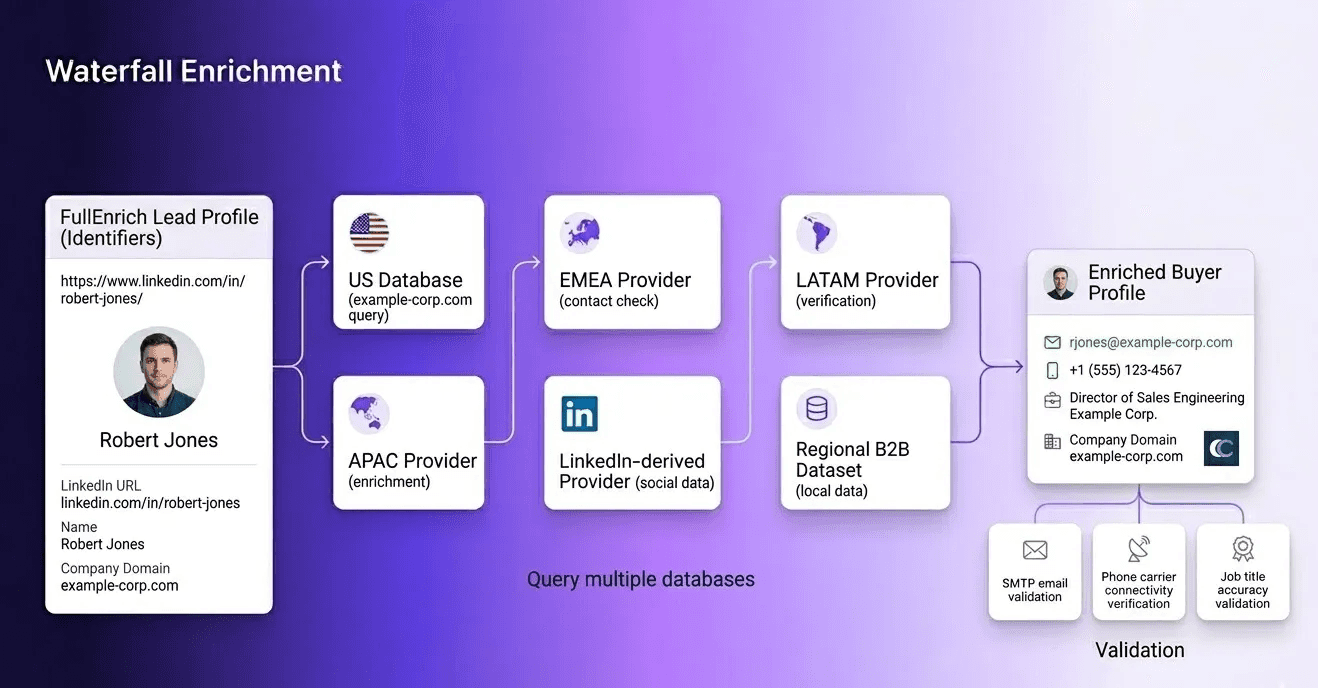
The core problem in sales lead enrichment is coverage. No single provider holds complete, verified data on every professional across every geography. US-centric databases have weak EMEA results. LinkedIn-derived providers miss contacts with limited public profiles. Regional providers fill geographic gaps but create others.
FullEnrich aggregates 20+ data providers into a single waterfall. When a record is submitted, FullEnrich routes it to the optimal provider for that record's geography and profile type first, then continues sequentially until the record is complete or all sources are exhausted.
FullEnrich achieves an 80%+ find rate across email and phone, with regional performance reaching 89% for US and Canada email, 84% for EMEA, and 78% for LATAM and APAC.
Every result passes triple verification before delivery: SMTP email validation, carrier phone connectivity, and job title accuracy checks. Failed lookups cost nothing under the pay-on-success credit model. Annual credits roll over, and unlimited seats mean the entire sales team accesses the same verified data without per-seat licensing constraints.
For sales data enrichment workflows specifically, high match rates combined with real-time verification means reps receive profiles ready to use, not profiles that still require manual checking before the first outreach attempt.
Start enriching your sales leads with FullEnrich
Conclusion
It is to be noted that sales lead enrichment is different from lead enrichment in scope. Sales lead enrichment is wired specifically to the outbound motion, equipping SDRs, BDRs, and AEs with the intelligence needed to reach the right person, with the right message, at the right time.
Sales lead enrichment is the operational layer between a contact list and a working outbound campaign. Without it, reps work from incomplete records, personalization is surface-level, and data decay makes a campaign that was barely viable at launch unusable within a quarter.
The four data layers, firmographic, professional, technographic, and chronographic, each remove a different failure mode from the outbound process.
Waterfall enrichment across 20+ providers ensures match rates are high enough for those layers to actually populate. Triple verification ensures what is returned is accurate enough to use without additional checking.
Frequently Asked Questions
What is the difference between lead generation and sales lead enrichment?
Lead generation identifies prospects who match a target profile. Sales lead enrichment takes those prospects and appends the verified contact data, firmographic context, and intent signals needed to actually reach them. Lead generation creates the list. Enrichment makes the list actionable.
How often should sales lead data be refreshed?
Active outbound targets should be re-enriched every 60 to 90 days. B2B contact data decays at 22.5% annually, with job titles changing at 65.8% per year. A record accurate at the start of a quarter may have a stale title, wrong email, or disconnected mobile by the end of it.
What makes waterfall enrichment different from single-source tools?
Single-source tools query one database and stop. Waterfall enrichment queries 20 or more providers sequentially, filling gaps across sources until the record is complete. The practical difference is match rate: 40 to 60% for single-source versus 80%+ for waterfall across a typical B2B contact list.
Can enrichment find personal email addresses and mobile numbers?
Yes. FullEnrich returns both work email and personal email where available, along with verified mobile numbers sourced from carrier databases. Personal email and direct mobile are particularly valuable because they bypass corporate filters and switchboards.
Does sales lead enrichment work for international prospecting?
Coverage quality varies significantly by provider and geography. Waterfall enrichment with geographic routing outperforms single-source tools for international lists by directing each record to the strongest regional provider before continuing the sequence. FullEnrich reaches 84% email find rates for EMEA and 78% for LATAM and APAC.
Is enriched data GDPR and CCPA compliant?
FullEnrich operates on a fetch-on-demand model rather than maintaining a static warehouse of stored personal data. Data is retrieved from verified, compliant sources at the time of the enrichment request. This approach aligns with GDPR and CCPA requirements around data minimization and on-demand retrieval.



Other Articles
Cost Per Opportunity (CPO): A Comprehensive Guide for Businesses
Discover how Cost Per Opportunity (CPO) acts as a key performance indicator in business strategy, offering insights into marketing and sales effectiveness.
Cost Per Sale Uncovered: Efficiency, Calculation, and Optimization in Digital Advertising
Explore Cost Per Sale (CPS) in digital advertising, its calculation and optimization for efficient ad strategies and increased profitability.
Customer Segmentation: Essential Guide for Effective Business Strategies
Discover how Customer Segmentation can drive your business strategy. Learn key concepts, benefits, and practical application tips.