

Marketing data enrichment is not a one-time data cleanup. It is an ongoing process of keeping your contact and account records current, complete, and verified so every campaign, sequence, and workflow operates from a foundation of accurate information.
If your campaigns are underperforming, your MQL quality is inconsistent, or your email bounce rates are creeping up, the root cause is almost always data quality.
This playbook covers what marketing data enrichment is, how B2B teams apply it across their workflows in 2026, how to build an enrichment process that scales, and the mistakes that most teams are still making.
What Is Marketing Data Enrichment?
Marketing data enrichment is the process of appending missing, outdated, or incomplete information to your existing contact and account records by pulling from external data providers to build profiles that are accurate, complete, and actionable.
For B2B marketing teams, this means adding firmographic data (company size, industry, revenue), technographic data (tech stack, tools in use), and contact-level data (verified work emails, direct dials, job titles) to every lead in your CRM.
The result is a database that actually supports segmentation, ABM targeting, lead scoring, and personalized outreach. It stops quietly sabotaging all four.
The three core enrichment types serve different marketing functions, and understanding the distinction helps you prioritize what to enrich first.
Contact Enrichment vs. Firmographic Enrichment vs. Technographic Enrichment
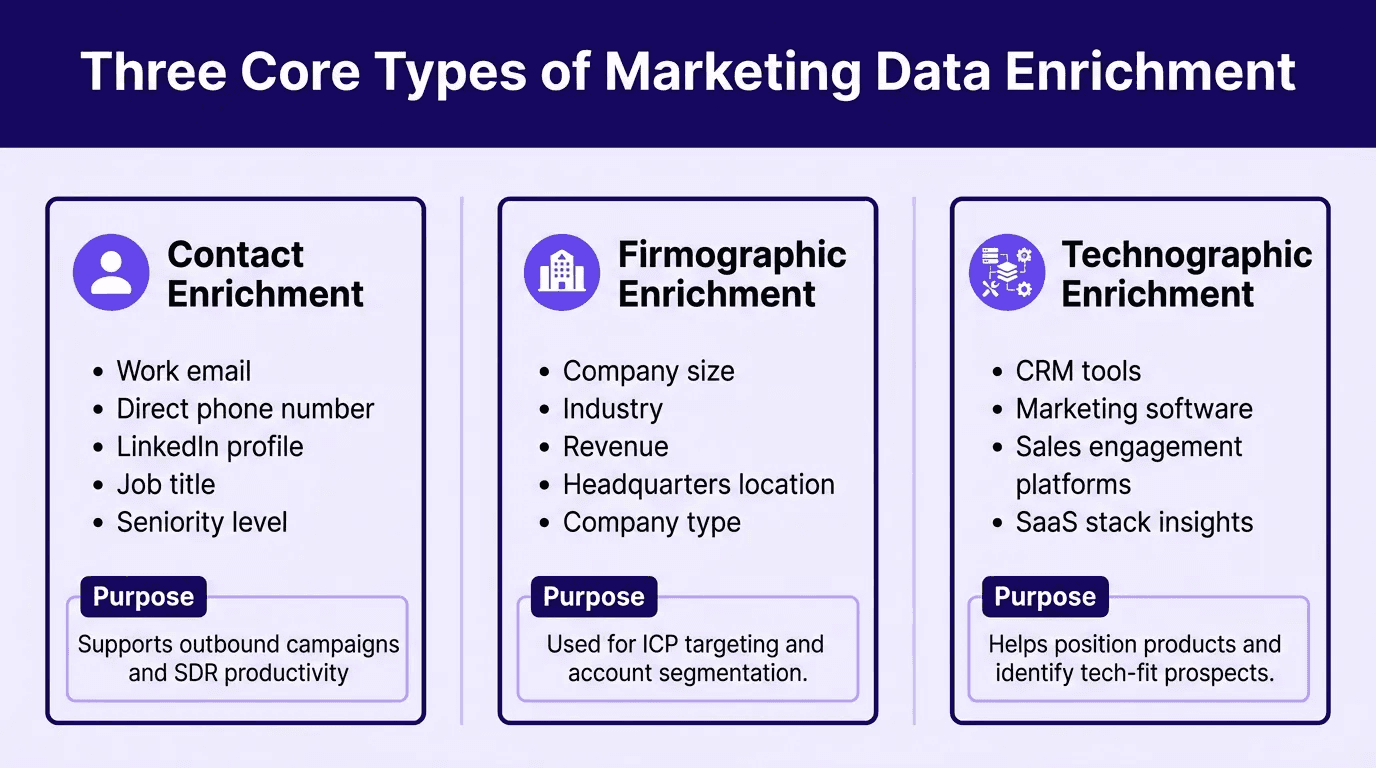
Contact enrichment fills in the personal and professional details tied to individual leads: work email, direct mobile number, LinkedIn profile, job title, and seniority level. This layer powers outbound sequences, email deliverability, and SDR productivity. Without it, you are running campaigns against incomplete profiles.
Firmographic enrichment adds company-level attributes including industry classification, employee headcount, annual revenue, headquarters location, company type, and founding date. This is the foundation for ICP filtering, territory planning, and ABM target list building. If you cannot confidently filter your database by company size or industry, your firmographic data needs work.
Technographic enrichment reveals what software and tools a target company currently uses. For SaaS vendors, this is particularly valuable: knowing that a prospect runs HubSpot for CRM and Salesloft for sequences tells you exactly how to position your product and which competitors to address in messaging. It also narrows your ICP to accounts already using complementary or competing tools, which reduces wasted spend on accounts outside your addressable market.
All three layers work together. A contact record without firmographic context gets miscategorized. A company record without verified contacts cannot be activated for outbound. Enrichment only delivers its full value when all three layers are present.
How Data Decay Kills Marketing Performance?
B2B contact data decays at approximately 22.5% annually, according to research cited by Marketing Sherpa. In high-turnover sectors like SaaS and tech, that rate can reach 70% per year. A database that looked clean in January can be nearly a quarter outdated by December, and you may not realize it until bounce rates spike and pipeline numbers fall short.
The mechanics of decay are predictable. 70.8% of business contacts experience at least one change within 12 months including job title shifts, company moves, email address changes, and phone number updates.
When someone leaves a company, their email address typically becomes invalid within days. Their direct dial gets reassigned. The person who now holds that title may not even exist in your CRM.
Poor data quality costs U.S. businesses $3.1 trillion annually, with individual organizations losing an average of $12.9 million per year through wasted marketing spend and lost pipeline. For a SaaS company running aggressive outbound, even a 22% decay rate on a database of 50,000 contacts means roughly 11,000 contacts per year becoming unreachable. That represents hundreds of thousands of dollars in potential pipeline, gone.
The only way to combat decay is continuous enrichment. Quarterly cleanups are not sufficient. Real-time validation at the point of data entry, combined with automated re-enrichment on a rolling cadence, is the 2026 standard for any marketing team that takes data quality seriously.
How B2B Marketing Teams Use Enriched Data?
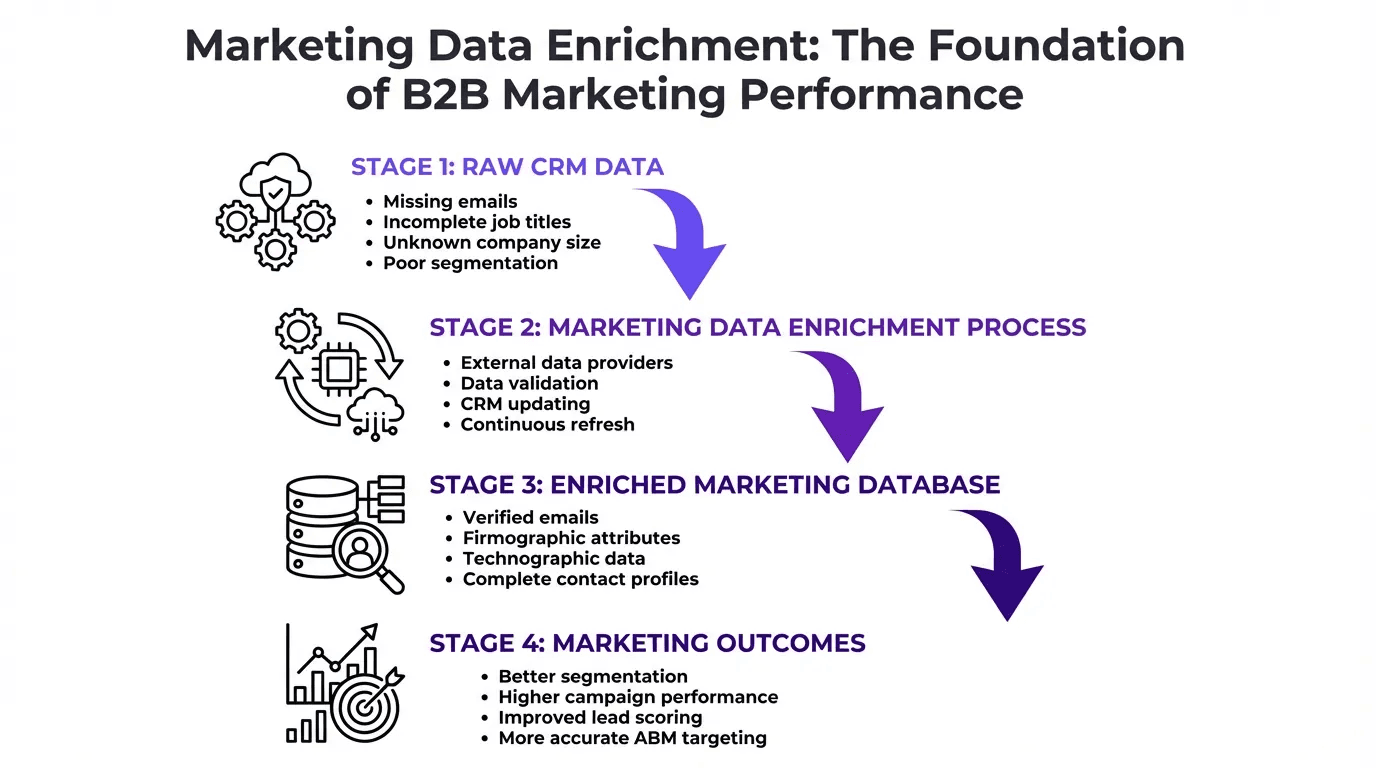
Enriched data is not just a hygiene concern. It is an active performance driver. When your contact and account records are complete and current, it changes what your marketing team is actually capable of executing. Here is how the most impactful use cases break down.
Account-Based Marketing (ABM)
ABM lives or dies on data quality. You cannot build a credible target account list without accurate firmographic data. You cannot run multi-threaded outreach into a buying committee without complete contact records. And you cannot personalize messaging at the account level without knowing who holds which title at which company.
Enrichment turns your ICP from a hypothesis into a filter. With firmographic data appended to every account in your CRM, you can segment by revenue band, headcount, industry, and tech stack, pulling only the accounts that match your buyer profile.
Contact enrichment then populates those accounts with verified decision-maker profiles: the VP of Marketing, the Head of RevOps, the CTO. Every contact has a verified email and a direct mobile number, reducing the time your team spends researching and increasing the time spent in actual conversations.
For ABM programs running 50 to 500 target accounts, this level of contact completeness is not optional. A single missing contact at a high-priority account is a missed opportunity at your most important pipeline source.
Ready to build ABM lists that actually convert? Try FullEnrich free. 50 credits, no credit card required.
Email Deliverability and Campaign Performance
Your email sender reputation is one of your most valuable marketing assets. Bad data is the fastest way to destroy it. Every bounce is a signal to email service providers that your list hygiene is poor. Enough bounces, and your domain ends up in spam folders, which means even your valid contacts stop seeing your emails.
Email decay reached 3.6% in a single month in November 2024, nearly double the traditional monthly rate, according to RevenueBase, which tracks changes across millions of B2B contact records. The implication for marketing teams is stark: enrichment cadences that made sense two years ago are no longer aggressive enough.
Triple email verification checks each address against multiple independent validators before it enters a campaign and reduces bounce rates to under 1%. That threshold protects deliverability, maintains sender reputation, and ensures your campaigns actually reach inboxes. Single-verification approaches that check once and move on are no longer sufficient given the current rate of email decay.
Lead Scoring and MQL Accuracy
Lead scoring only works when the data inputs are reliable. A model that scores a lead as high-priority based on job title and company size falls apart when those fields are blank, outdated, or wrong.
The result is MQLs that are not actually qualified, which erodes trust between marketing and sales, increases SDR time wasted on poor leads, and inflates your cost per opportunity.
Firmographic enrichment fixes this at the record level. When every contact in your database has verified company size, industry, revenue range, and job seniority attached, your lead scoring model operates on real data rather than guesswork. Leads that match your ICP score higher.
Leads that do not, score lower or get deprioritized entirely. The MQLs that reach your sales team actually look like your best customers.
The downstream impact is measurable. Clean data drives 20% better campaign response rates and 15% higher close rates within six months, according to GTM benchmarks. That uplift comes almost entirely from better targeting. That comes from better data.
Audience Segmentation and Personalization
McKinsey research found that 71% of consumers expect companies to deliver personalized interactions, and 76% get frustrated when they do not. In B2B, where buying decisions involve multiple stakeholders and longer cycles, personalization is even more critical. It is harder to execute without enriched data.
Segmentation based on enriched records goes beyond basic demographic buckets. With firmographic and technographic data appended, you can build segments like: SaaS companies with 100–500 employees using Salesforce, currently in a hiring surge for sales roles.
That combination of attributes signals budget, growth, and active investment in sales infrastructure, which is a far more actionable audience than "mid-market technology company."
Enriched data also powers dynamic personalization tokens in email and landing pages. When you know a contact's job title, company size, and industry, you can serve them messaging that reflects their specific context. A generic pitch that treats everyone the same wastes the data you worked to collect.
How to Build a Marketing Data Enrichment Workflow in 2026
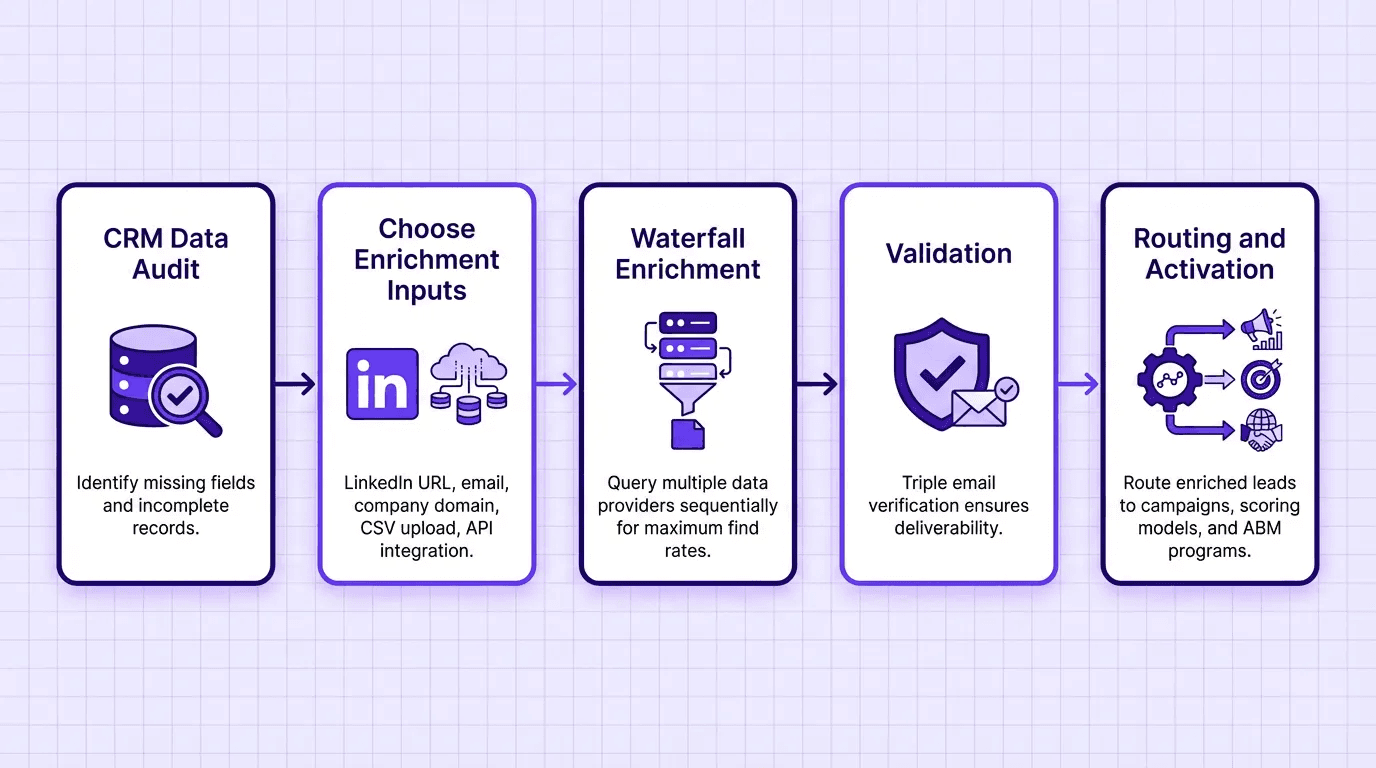
Building an enrichment workflow that actually runs is a different challenge from knowing why enrichment matters. Most teams that struggle with data quality are not failing because they lack intent. They fail because enrichment is treated as a manual, occasional task rather than an automated, continuous process. The four steps below apply whether you are building from scratch or fixing an existing workflow.
Step 1: Audit Your CRM for Data Gaps
Before enriching anything, you need to know what is actually broken. Run a data audit across your CRM to identify the percentage of records missing key fields: email, phone, job title, company size, industry, and LinkedIn URL.
Most B2B marketing teams doing this for the first time find that 91% of CRM records are incomplete in some way, with significant percentages missing direct contact information entirely.
Prioritize your audit around the data points that directly affect campaign performance: email validity (deliverability), job title (lead scoring), and company size and industry (ICP filtering). Fix those three layers first before moving into technographic or behavioral enrichment.
Step 2: Choose Your Enrichment Inputs
Your enrichment inputs determine what data you can append. The most common input methods for B2B marketing teams are:
LinkedIn URL enrichment by using a contact's LinkedIn profile as the primary identifier to pull job title, company, location, and seniority data
Name plus company domain matches a name and company URL to pull verified email and phone
CSV or bulk upload lets you upload a list of contacts and receiving enriched records back in batch
API integration enriches records in real time as they enter your CRM or marketing automation platform
For demand gen teams running inbound, API enrichment at the point of form submission is the most efficient approach: every new lead gets enriched automatically before it enters any workflow or scoring model.
Step 3: Single-Source Enrichment vs. Waterfall Enrichment
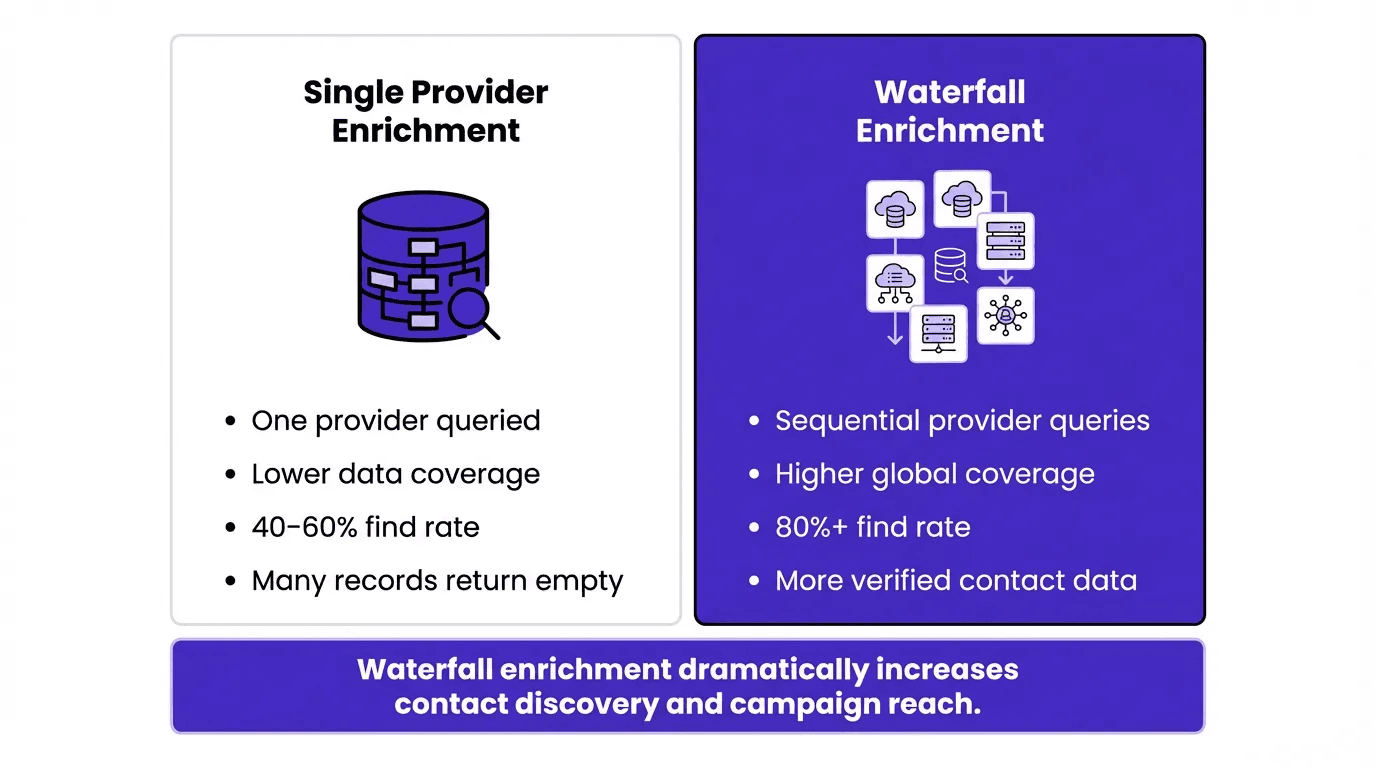
This is the decision that has the greatest impact on your find rate: the percentage of records that come back with verified, usable data.
Single-source enrichment queries one data provider. If that provider does not have a record for your contact, you get nothing. For most providers, find rates range from 40% to 60% depending on geography and industry. That means up to half of your enrichment attempts fail.
Waterfall enrichment queries multiple providers sequentially. If Provider A does not find a verified email for a contact, the request automatically moves to Provider B, then Provider C, and so on until a valid record is found or all sources are exhausted. This cascading approach dramatically increases find rates without requiring you to manage multiple vendor contracts or integrations.
The practical difference is significant. Where a single provider might find verified contact data for 55% of your list, a waterfall approach covering 20+ providers can push that find rate above 80%.
Step 4: Enrich, Validate, Route
Enrichment and validation are not the same step. Enrichment appends data. Validation confirms that the appended data is correct and deliverable before it enters any campaign or workflow.
Triple email verification checks each address across three independent validators and is the current standard for maintaining a bounce rate under 1%. Single verification catches obvious errors but misses catch-all addresses, recently deactivated accounts, and domain-level issues.
Once records are enriched and validated, automated routing ensures they reach the right workflow. A VP-level contact at a 200-person SaaS company should route into a different sequence than a Marketing Manager at a 30-person startup, even if both came in through the same form. Enriched firmographic data makes that routing logic possible.
Common Marketing Data Enrichment Mistakes
Most teams that invest in enrichment still leave significant performance on the table by making predictable mistakes. These are the ones that appear most often.
Enriching once and assuming the work is done. Data decays continuously. A record that was accurate when it was enriched six months ago may already have an invalid email and a changed job title. Enrichment needs to run on a rolling cadence. Not as a one-time import.
Enriching the entire database before filtering for ICP fit. Enriching records that will never match your buyer profile wastes credits and time. Run ICP filtering first, then enrich the records that pass. This keeps enrichment costs proportional to potential pipeline value.
Relying on a single data provider. No single provider has complete coverage across all geographies, company sizes, and industries. Teams that rely on one vendor accept whatever gaps that vendor has in their dataset. A waterfall approach eliminates this constraint.
Skipping email validation after enrichment. Enrichment finds an email address. Validation confirms it will actually deliver. Skipping validation means sending campaigns to addresses that look valid but will bounce. It damages your sender reputation in the process.
Not connecting enrichment to lead scoring. Enriched data that sits in the CRM without feeding your scoring model adds no value to your pipeline prioritization. Wire enrichment directly into your scoring logic so that newly appended firmographic and contact fields update scores in real time.
How Does Data Enrichment Impact Marketing Specifically?
The benefits of data enrichment are often described in general terms: better segmentation, more personalization, higher ROI. But the impact is more specific and more structural than that. In marketing, data enrichment changes what is possible at every stage of the demand generation funnel.
Inbound Lead Qualification
When a prospect fills out a form, they typically provide minimal information: name, email, sometimes a company name. Without enrichment, that record sits in the CRM as an incomplete contact that cannot be scored, segmented, or routed reliably.
Enrichment runs automatically when the form is submitted, appending job title, company size, industry, seniority, and technology stack before the record touches any workflow. The result is a fully qualified, scoreable contact routed to the right SDR and enrolled in the right sequence from the moment they convert, not after a manual research step.
Enriched leads also unlock progressive profiling. Instead of front-loading forms with a dozen fields that reduce completion rates, marketing teams collect only the essentials and let enrichment supply the rest. Research consistently shows that reducing form fields from 11 to 4 can increase completion rates by more than 50%.
Account-Based Marketing
ABM strategy depends entirely on data quality. Building a target account list, defining buying committee members, personalizing content by persona, and sequencing multi-channel touches all require accurate firmographic and demographic data at the account level.
Enrichment makes ABM operationally viable. Without it, ABM teams either manually research every target account (a process that does not scale) or run ABM on incomplete data (a process that does not convert). With continuous enrichment, the target account list stays current, buying committee contacts are verified, and personalization tokens in emails and landing pages reflect accurate data rather than stale CRM fields.
B2B companies that enrich their firmographic data experience a 12% increase in conversion rates, according to Demandbase research. For ABM programs targeting high-value accounts, that conversion improvement compounds directly into revenue.
Email Marketing and Deliverability
Every email marketing program operates within a deliverability budget. Gmail and Outlook track bounce rates, spam complaints, and engagement rates at the domain level. A sender whose bounce rate exceeds 2 to 3% faces inbox placement penalties that affect all future sends, not just the campaigns generating the bounces.
Data enrichment with real-time email validation prevents this degradation. Before any enriched email address enters a sequence, it is verified against live mail server records to confirm the address is active and deliverable. FullEnrich's triple email verification process is designed to keep bounce rates below 1%, protecting sender reputation across the entire domain.
Lead Scoring and Routing
Lead scoring models require data to score against. A scoring model that assigns points for company size, seniority, and technology fit only works when those fields are populated. An incomplete CRM record cannot be scored accurately, which means it either routes to the wrong SDR, enters the wrong sequence, or sits in a holding queue until someone manually researches the gaps.
Enrichment ensures that scoring models have the inputs they need to function correctly. When every inbound record arrives with verified firmographic and demographic data, scoring becomes reliable. Routing fires correctly. Pipeline velocity improves because leads reach the right rep at the right time rather than passing through a manual triage step.
Segmentation and Personalization at Scale
Personalized outreach requires segmented audiences. Segmented audiences require clean, enriched data. The chain is direct. A marketing team cannot build a segment of VP-level decision-makers at Series B SaaS companies with 50 to 200 employees unless every contact record in the CRM has accurate title, seniority, company stage, and headcount fields populated.
Enrichment is what makes meaningful segmentation possible beyond the most basic demographic splits. Teams that enrich continuously can build segments based on technographic fit (prospects using a competing tool), intent signals (accounts actively researching the category), and behavioral engagement (contacts who have visited key pages in the last 30 days), producing campaigns that are fundamentally more targeted than what unenriched data allows.
How FullEnrich Supports B2B Marketing Teams?
For marketing teams running high-volume outbound, ABM programs, or demand gen workflows that depend on CRM data quality, FullEnrich provides waterfall enrichment across 20+ premium data providers, including Apollo, Lusha, ZoomInfo, Hunter, Datagma, and ContactOut. All under a single subscription.
The waterfall approach means each enrichment request cycles through all available providers sequentially until a verified match is found, rather than stopping after one attempt. This produces an overall find rate above 80%, with regional coverage across US/Canada (email 89%, phone 86%), EMEA (email 84%, phone 71%), LATAM (78%/67%), and APAC (78%/66%), making it particularly effective for teams running international campaigns.
Triple email verification keeps bounce rates under 1%, which directly protects sender reputation and campaign deliverability. For marketing teams sending at volume, that threshold matters more than almost any other metric.
The pricing model charges credits only on successful enrichments. Not on attempts, which means you are never paying for records that come back empty. Unlimited seats allow your full marketing, demand gen, and RevOps team to work within the same account without per-user fees stacking up.
Thomas Rebaud, ex-CEO at Meero and investor in 32 startups, had a clear take after running comparisons: "We've tried ZoomInfo, Cognism, Lusha, and others… FullEnrich beats all of them when you want to find the emails and phone numbers of prospects."
Victor Alexandrian, COO at Scalability, described the workflow impact directly: "FullEnrich outclasses every other solution. We send 100k+ outbound emails every month, and using a waterfall enrichment strategy doubled our enrichment rate."
Conclusion
Marketing data enrichment is not a data team problem. It is a revenue problem. Incomplete contact records, decaying CRM data, and single-source gaps compound into lower deliverability, inaccurate lead scoring, ineffective ABM, and campaigns that miss the people they were built to reach.
The teams that outperform in 2026 treat enrichment as infrastructure: automated, continuous, and directly wired into every workflow that depends on contact and account data. The foundation starts with knowing what you have, identifying the gaps, and choosing an enrichment approach that can actually cover your full market and not just the easy records that a single provider can find.
See what your team's find rate looks like. Start free with 50 credits, no credit card needed.
FAQs
What is the difference between data enrichment and data cleansing?
Data cleansing removes inaccurate, duplicate, or malformed records from your database. Data enrichment adds missing information to records that already exist. Both are necessary. Cleansing should precede enrichment so you are not enriching records that should be deleted.
How often should B2B marketing teams re-enrich their database?
Given that B2B contact data decays at 22.5% annually, with email decay accelerating to 3.6% per month in late 2024. Continuous enrichment is the current standard. At minimum, re-enrich active segments quarterly. For high-priority target accounts, monthly or real-time re-enrichment through CRM API integration is more appropriate.
What enrichment inputs produce the highest match rates?
LinkedIn URL is the most reliable input for B2B contact enrichment because it is a persistent, unique identifier that does not change when someone switches jobs. Name plus company domain is the second most reliable. Email-only enrichment produces lower match rates because email addresses change frequently.
Does data enrichment comply with GDPR and CCPA?
Compliance depends on how enrichment data is sourced. On-demand enrichment, where data is fetched in real time and not stored in a proprietary database, is the most defensible approach under GDPR, since no personal data sits in a database waiting to be accessed. Providers that maintain static databases of personal data carry higher compliance risk for European and Californian records.
How does waterfall enrichment differ from standard single-source enrichment? Single-source enrichment queries one provider per request. If that provider has no record, the attempt returns empty. Waterfall enrichment queries multiple providers sequentially until a verified match is found, which typically produces find rates 20–40% higher than single-source approaches on the same contact list.
Can marketing teams use enrichment for inbound leads, not just outbound lists?
Yes, and it is one of the highest-value applications. When a lead submits a form with only their email and company name, API-based enrichment can instantly append job title, seniority, company size, and industry before the record enters your CRM or scoring model. This means inbound leads are fully profiled at the point of capture rather than requiring manual research or leaving scoring fields blank.
Build a marketing database your campaigns can actually rely on. Try FullEnrich free. 50 credits, no credit card required.



Other Articles
Cost Per Opportunity (CPO): A Comprehensive Guide for Businesses
Discover how Cost Per Opportunity (CPO) acts as a key performance indicator in business strategy, offering insights into marketing and sales effectiveness.
Cost Per Sale Uncovered: Efficiency, Calculation, and Optimization in Digital Advertising
Explore Cost Per Sale (CPS) in digital advertising, its calculation and optimization for efficient ad strategies and increased profitability.
Customer Segmentation: Essential Guide for Effective Business Strategies
Discover how Customer Segmentation can drive your business strategy. Learn key concepts, benefits, and practical application tips.