

Data enrichment is the programmatic process of appending external data to internal records using a "seed" identifier, such as a corporate email or domain. It transforms a basic contact record into a multi-dimensional profile by layering in firmographic, technographic, and intent-based attributes.
This process is a non-negotiable requirement for modern sales teams because B2B data decays at a rate of roughly 2.1% per month. Without automated updates, nearly a quarter of a database becomes obsolete every single year. Instead of relying on manual research, enrichment platforms use waterfall logic to query multiple data providers until a match is found.
This guide breaks down the underlying mechanics of API orchestration, the critical distinction between enrichment and enhancement, and how to verify data freshness at scale.
Data Enrichment vs. Data Enhancement
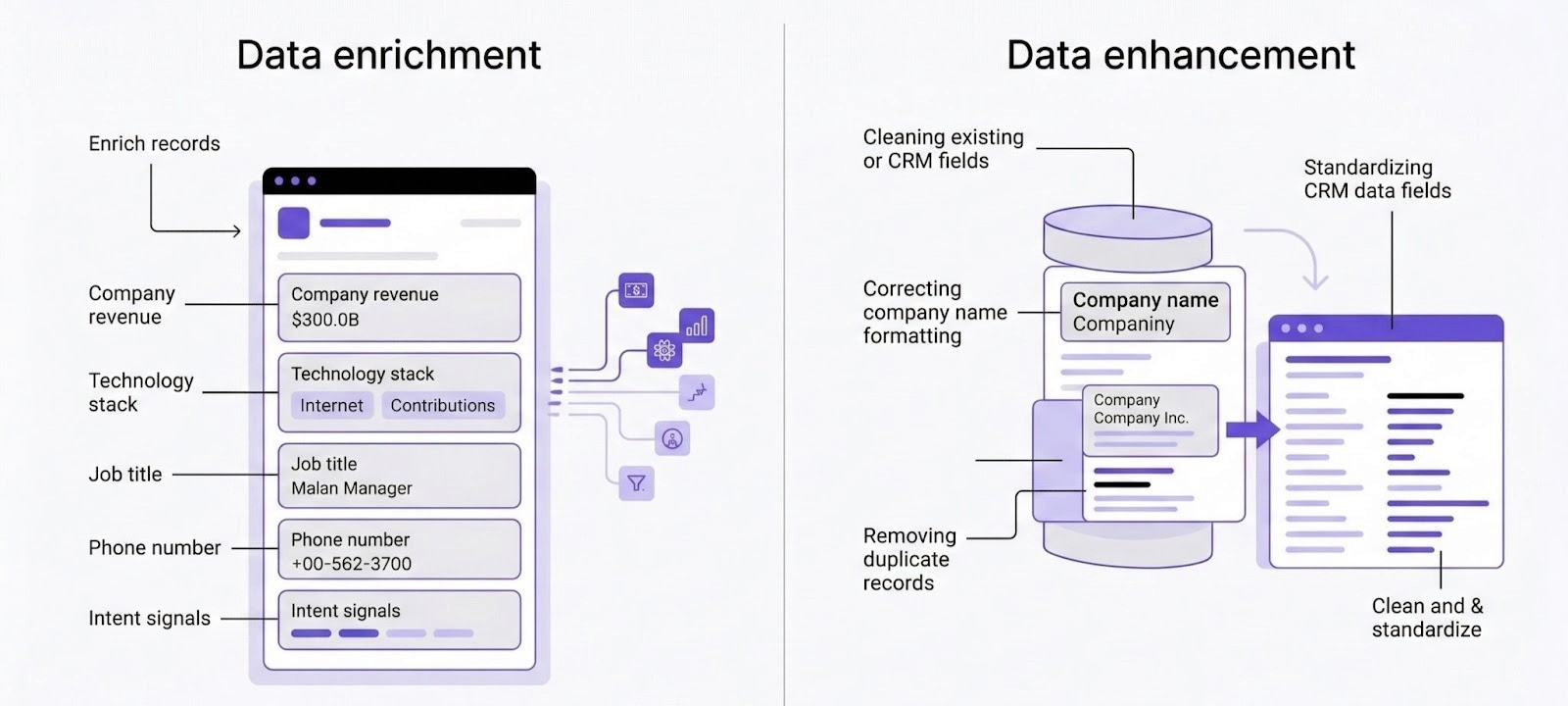
Distinguishing between data normalization and data enrichment is critical for maintaining a functional CRM schema. While these terms are often conflated, they represent two distinct stages of the data hygiene lifecycle.
Data normalization focuses on refining existing records. This process involves standardized formatting of strings to ensure database consistency across the entire organization. Normalization scripts convert inconsistent entries into proper cases and resolve common typos in corporate domains.
More importantly, this layer maps varied industry descriptions to a single, unified industry code, such as NAICS or SIC. Standardizing these "seed" fields is a prerequisite for successful automation because it ensures that downstream API queries use the most accurate identifiers.
Feature | Data Enhancement | Data Enrichment |
Primary Goal | "Seed" data hygiene and string standardization | Multi-source attribute appending. |
Action Taken | Case correction, duplicate resolution, and NAICS/SIC mapping. | Waterfall API orchestration and JSON payload merging. |
Source | Internal (manipulating existing CRM fields). | External (querying 15+ premium third-party providers). |
Result | A cleaner, more professional database | Reliable "seed" data for high-match API calls. |
Data enrichment is primarily additive. It uses the normalized record to pull in entirely new attributes from external third-party sources. If normalization fixes a misspelled company name, enrichment appends that company’s annual revenue, current tech stack, and headquarters location.
How Data Enrichment Works? The Step-by-Step Process
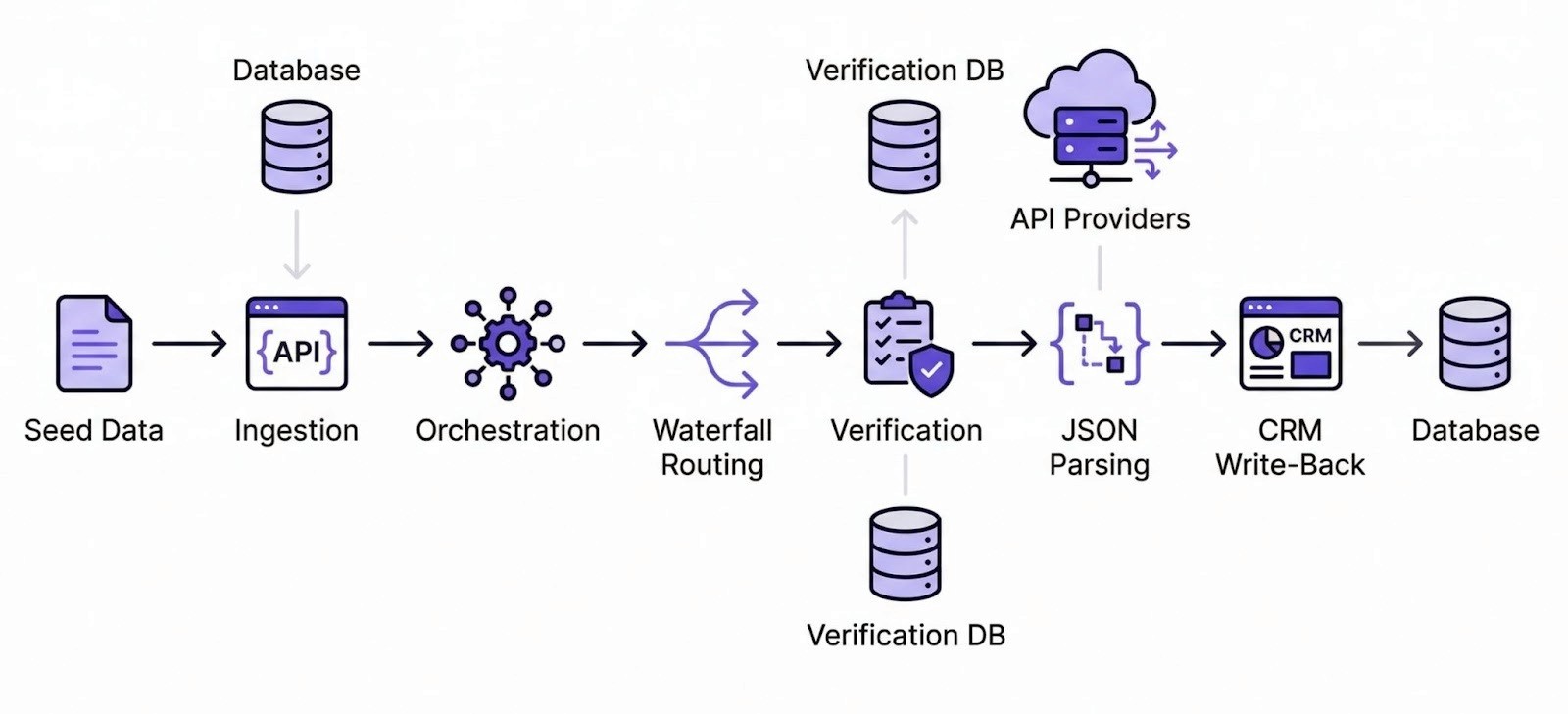
Modern data enrichment is an automated engineering workflow rather than a simple database lookup. In a 2026 RevOps environment, the most reliable systems utilize a multi-stage pipeline to ensure that appended attributes are both accurate and deliverable.
This process follows a rigorous technical sequence to transform a single identifier into a multi-dimensional buyer profile.
1. Seed Data Normalization and Ingestion
The cycle begins with the ingestion of a primary identifier, typically a corporate email address or a LinkedIn URL. Before querying external vendors, the system standardizes this "seed" data to remove syntax errors or formatting inconsistencies. This step is critical because poorly formatted input can cause API matches to fail. Once normalized, the identifier acts as the technical key for the subsequent orchestration layers.
2. API Orchestration and Waterfall Routing
Instead of relying on a single static database, the enrichment engine initiates a waterfall routing sequence. The system queries a primary high-tier data provider via API. If that provider returns a null value or a low-confidence match, the engine instantly rotates to secondary and tertiary providers.
This sequential querying continues until a match is confirmed, maximizing the total coverage rate across different geographic regions and industries.
3. Multi-Layer Verification (SMTP and Carrier Pings)
Once a data point is located, the system immediately verifies its validity. For email addresses, this involves an SMTP handshake to verify the mailbox is active without sending a physical message. For mobile numbers, the system uses carrier pings to verify that the line is currently in service.
This layer of real-time validation prevents the CRM from being populated with "dead" or "catch-all" contact information that would otherwise damage the sender's reputation.
4. JSON Parsing and Schema Mapping
External data vendors return information in a structured JSON payload. The enrichment engine parses this file and maps the attributes to the specific fields within the internal CRM schema. During this stage, the system resolves naming inconsistencies, ensuring that job titles such as "Head of Sales" and "VP, Sales" are categorized under a single, unified seniority tier.
5. Write-Back Execution and Governance
The final stage involves pushing the formatted data back into the system of record. This write-back can occur in real time as leads are created, or in high-volume batches for database maintenance. During this phase, the system strictly enforces field-level security and overwrite rules.
If a sales representative has already entered a verified phone number, the governance layer blocks the automated system from altering that specific field.
What are The Common Types of Data Enrichment?
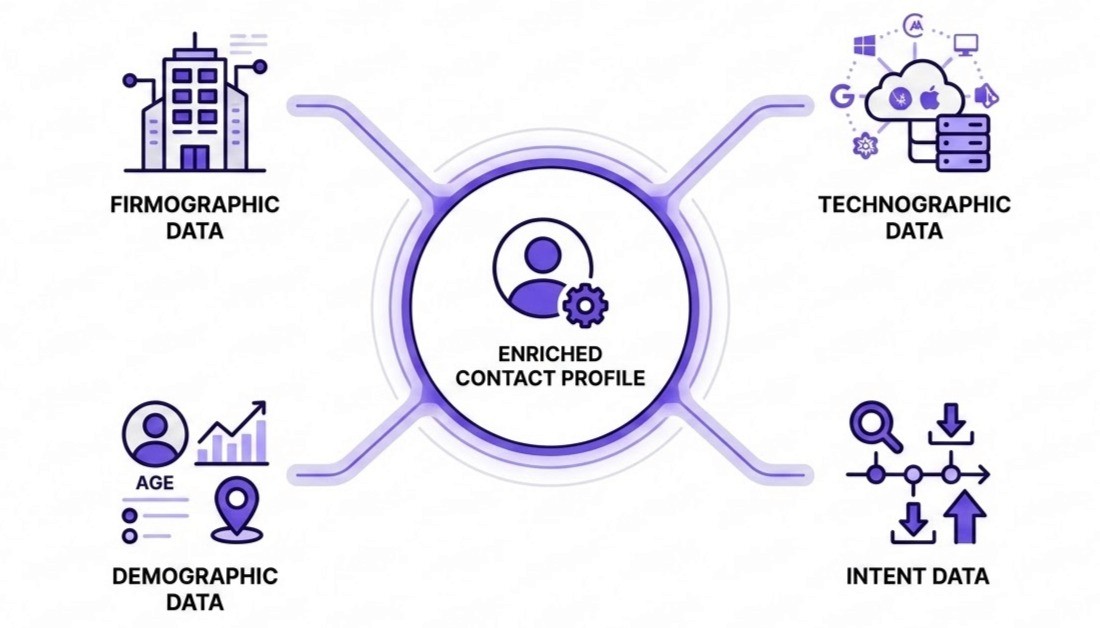
To build a comprehensive prospect profile, systems must aggregate different categories of information. GTM teams typically divide enrichment into four primary layers, each serving a specific function in the sales and marketing workflow.
1. Firmographic Enrichment (Organization Metrics): This layer establishes the structural profile of a target company. Beyond basic industry tags, firmographic enrichment standardizes annual revenue brackets and headcount growth velocity. High-quality systems map parent-child corporate hierarchies to ensure that leads are routed to the correct account owner based on global or regional territory definitions. It also includes the standardization of NAICS or SIC codes to allow for precise industry segmentation within the CRM.
2. Technographic Enrichment (Infrastructure Metrics): Technographics reveal the specific technological footprint of an organization. This data is not gathered through surveys but through the automated analysis of HTML headers, MX records, and DNS configurations. Knowing if a prospect utilizes specific cloud providers or CRM systems allows teams to execute "competitive swap" or "integration-led" sales plays.
3. Demographic and Professional Enrichment (Contact Metrics): This layer focuses on the individual buyer within the organization. It appends exact job titles, years of experience, and verified social media footprints. Sophisticated enrichment engines map these titles to internal seniority tiers. This categorization ensures that a "Director of Growth" and a "Head of Marketing" are recognized as the same persona for automated outreach.
4. Intent and Behavioral Data (Active Buying Signals): Intent data represents the active layer of a prospect's journey. It tracks behavioral signals such as surges in research across B2B content networks or changes in hiring patterns for specific technical roles. Enrichment platforms deanonymize IP addresses from corporate networks to identify which accounts are researching specific product categories. This intelligence transforms the CRM into a predictive tool.
Also read: What is CRM Enrichment and How Does It Work?
Techniques for Modern Enrichment: API vs. Batch vs. AI Agents
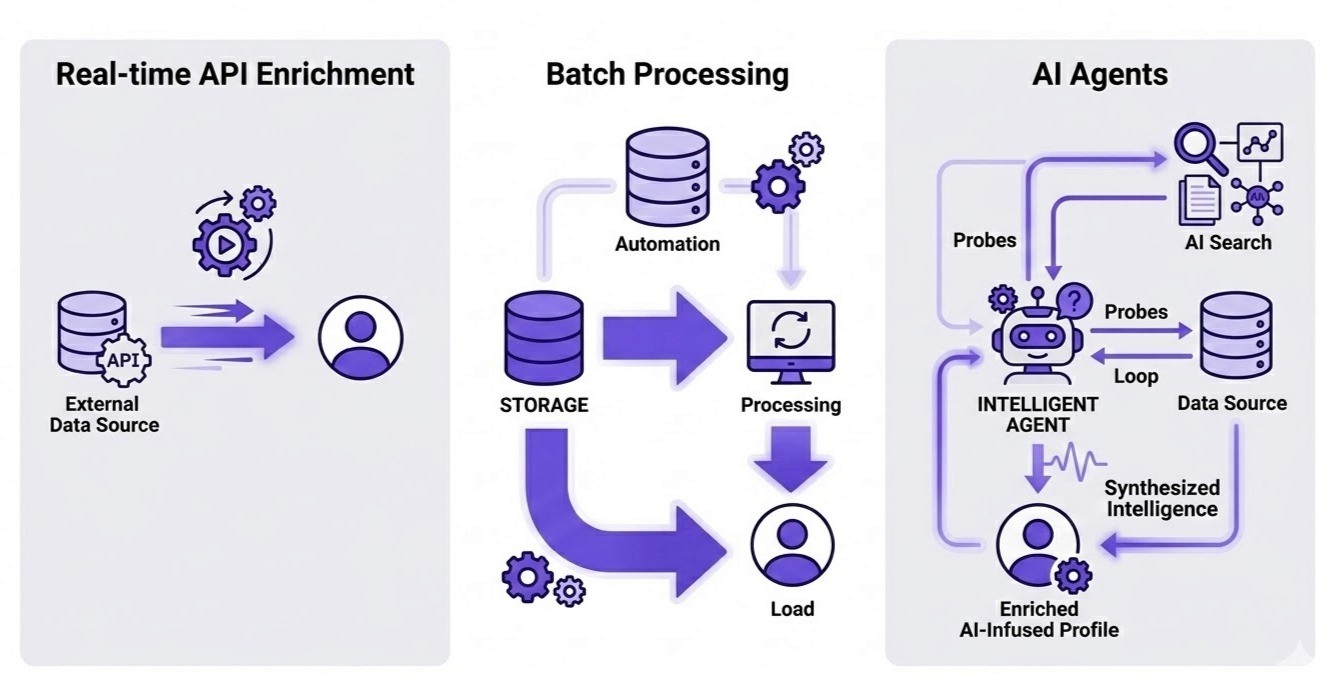
Data enrichment architecture has evolved beyond simple lookups. Strategy now dictates the technical choice. Selecting an approach depends on whether a team prioritizes speed, volume, or research depth.
1. Real-Time API Enrichment: Speed-to-lead requires an API. This method fires a call to external providers the millisecond a lead record is created. The engine ingests a JSON payload and appends attributes instantly. This execution is mandatory for automated routing. By the time a representative opens a record, the direct dials are already there.
2. Batch Processing: Batching is for scale. It processes thousands of records in a single scheduled cycle. This is the primary weapon against data decay across an entire system of record. Organizations use it for quarterly TAM updates to ensure segments remain accurate as companies restructure. It is cost-effective. It is thorough. It handles the "deep cleaning" of the database without taxing real-time resources.
3. Autonomous AI Agents: This is the new frontier. Unlike static databases, agents use LLMs to browse the live web and synthesize unstructured information. They parse press releases and public job boards. This approach uncovers signals that databases miss. Agents identify geographic expansions or internal tech stack shifts in real-time.
Why Every GTM Team Needs Enrichment?
If you aren't using enrichment in 2026, you're likely working twice as hard for half the results. Here is why it has become a non-negotiable for high-growth teams:
Hyper-Personalization: We’ve moved past the era of "I saw your website." Enrichment gives you the context, like a recent promotion or a specific technology they just installed, to write an opening line that actually resonates.
Smarter Lead Prioritization: Not every lead is equal. Enrichment allows you to score leads based on their actual fit (like company revenue or funding stage) rather than just their email domain.
Improved Email Deliverability: High bounce rates are a fast track to the spam folder. Enrichment includes real-time verification, stripping away "dead" emails before you ever hit send.
Frictionless Inbound Forms: By using real-time enrichment, you can shorten your website forms to just an email address. The system fills in the remaining details (company size, industry, job title) in the background.
Also read: Top GTM Strategies in Data Enrichment to Try in 2026
Concrete use case for data enrichment
Data enrichment isn't just about making your CRM look pretty; it’s about making it functional. The most successful companies use enrichment to solve very specific problems across their sales, marketing, and customer success teams.
For Sales: Bypassing the Gatekeeper. Imagine an SDR is trying to reach a Director at a Fortune 500 company. Without enrichment, they are stuck calling the main office switchboard. With contact enrichment, they receive the Director’s direct mobile number and a verified personal email address. This small piece of data can be the difference between a booked meeting and a wasted week of leaving voicemails.
For Marketing: Shortening the Path to Conversion. We’ve all seen web forms that ask for ten different pieces of information. Most people just leave. Smart marketing teams now use real-time form enrichment. A visitor enters their email, and the system instantly pulls their company size, industry, and job title in the background. The visitor has a better experience, and the marketing team gets a fully qualified lead.
For Customer Success: Tracking "Champion" Movement. One of the biggest risks to any account is when your main point of contact (your "champion") leaves the company. Enrichment tools can track signals of job changes. When your champion moves to a new company, your CS team gets an alert. This allows them to reach out to the new person taking over and, even better, follow their old champion to their new company to start a new sales conversation.
What are The Best Practices for High-Quality Enrichment?
To get the most value out of your data, you need to treat enrichment as an ongoing strategy rather than a one-time project. Here are the standards for keeping your data in top shape:
Prioritize Your Ideal Customer Profile (ICP): Enrichment credits are a resource, so don't spend them on everyone. Focus your deepest enrichment efforts on the leads that actually match your best-case customer. There is no point in finding the direct dial for a lead that will never be a good fit for your product.
Establish a "Refresh" Schedule: B2B data decays at about 23% per year as people change jobs and companies restructure. To stay ahead of this, you should set up a quarterly refresh for your most important accounts.
Strict Compliance is Non-Negotiable: Privacy laws such as the GDPR (Europe) and the CCPA (California) will be enforced more strictly than ever. Always ensure your data provider is transparent about the source of their information. Look for providers that offer compliance-first data and have clear "Data Processing Agreements" (DPAs) in place to protect your business from legal risks.
Verify Before You Sync: Even the best databases can have occasional errors. The best practice is to use a tool that performs real-time verification (such as an SMTP check for emails) before the data ever reaches your CRM.
How to Choose a Data Enrichment Provider?
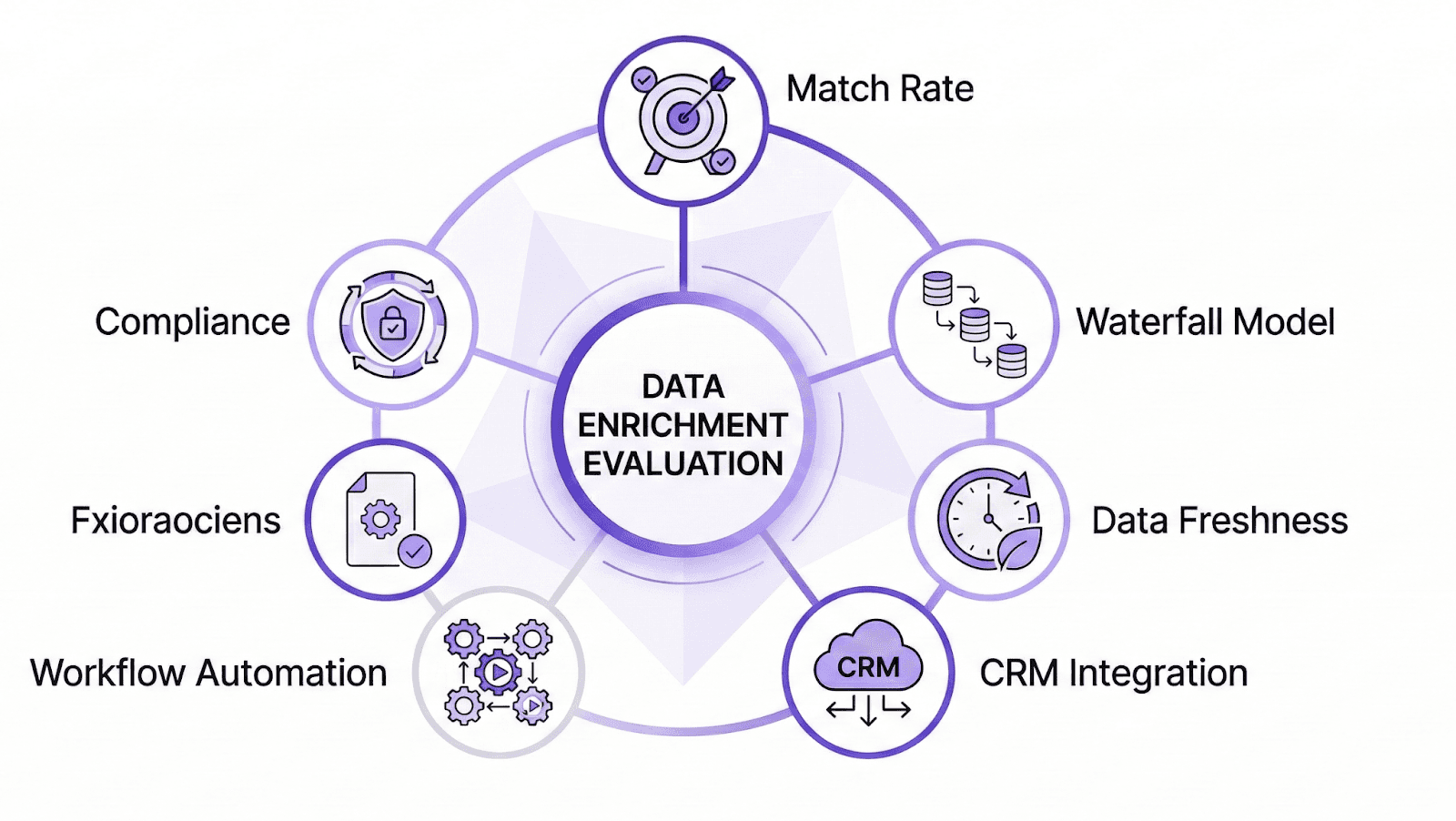
Selecting the right enrichment partner is less about finding the "biggest" database and more about finding the one that matches your specific GTM workflow.
You should start by evaluating a provider's match rate and data freshness, specifically looking for tools that offer "Waterfall" enrichment. A waterfall model is superior because it doesn't rely on a single, static internal database.
Beyond the data itself, you need to consider how well the tool integrates with your existing tech stack. A provider might have great data, but if it requires manual CSV uploads every day, it will quickly become a bottleneck for your sales team. Look for native, "in-place" enrichment that automatically updates your CRM records in the background.
Finally, never overlook compliance. Make sure your provider is transparent about their data sourcing and fully complies with global privacy laws such as GDPR and CCPA.
Transform Your Data into a Revenue Engine with FullEnrich
If you’re tired of hitting dead ends with outdated contact info, FullEnrich is built to give your team the direct line they’ve been looking for. We don’t just "search" for data; we verify it in real-time using a powerful waterfall engine that queries over 20 premium sources simultaneously.
Industry-Leading Match Rates: By checking multiple sources in a sequence, we find the direct mobile numbers and verified emails that other tools miss.
Verified for Deliverability: Every email is subjected to a triple-layer SMTP check to keep bounce rates low and your sender reputation high.
Success-Based Credits: You only pay for the data we actually find. If we can't verify a contact, you don't spend a credit.
Ready to see the difference? Sign up at FullEnrich.com today and get 50 free leads to test the system on your hardest-to-reach prospects.
Frequently Asked Questions (FAQs)
Is data enrichment the same as lead generation?
Not exactly. Lead generation is the act of finding new people to talk to. Data enrichment is about taking the people you already know and adding more depth to their profiles, like their direct phone number, tech stack, or recent company news.
Will enrichment create duplicate records in my CRM?
A good tool won't. Professional enrichment providers use unique identifiers (such as an email address or a LinkedIn URL) to match new data to your existing records, ensuring your CRM stays clean and organized.
How do I know if the data I’m getting is "fresh"?
Look for tools that perform "Real-Time Verification." This means the tool doesn't just pull an old phone number from its database; it performs a live check (like an SMTP handshake for emails) the moment you request it.
Is real-time enrichment better than batch?
Real-time is best for "speed-to-lead" (handling new sign-ups). Batch is better for "database hygiene" (cleaning up thousands of old records at once). Most successful teams use both.
What is the minimum info I need to start an enrichment search?
Usually, just a professional email address or a company domain is enough. The more you provide (like a first and last name), the faster and more accurate the match will be.
Does enrichment help with email deliverability?
Yes, significantly. By stripping out "dead" or "catch-all" emails before you hit send, enrichment keeps your bounce rate low, which signals to email providers that you are a legitimate sender.
Can I enrich data for international companies?
Yes, but coverage varies. Some tools are very strong in the US, while others (like FullEnrich) have a more global reach because they pull from 20+ different regional data providers.
How much does a typical enrichment service cost?
Most use a "credit-based" model. You can start for as little as $29/month for a few hundred credits, while enterprise plans scale up based on the volume of data you need to process.



Other Articles
Cost Per Opportunity (CPO): A Comprehensive Guide for Businesses
Discover how Cost Per Opportunity (CPO) acts as a key performance indicator in business strategy, offering insights into marketing and sales effectiveness.
Cost Per Sale Uncovered: Efficiency, Calculation, and Optimization in Digital Advertising
Explore Cost Per Sale (CPS) in digital advertising, its calculation and optimization for efficient ad strategies and increased profitability.
Customer Segmentation: Essential Guide for Effective Business Strategies
Discover how Customer Segmentation can drive your business strategy. Learn key concepts, benefits, and practical application tips.