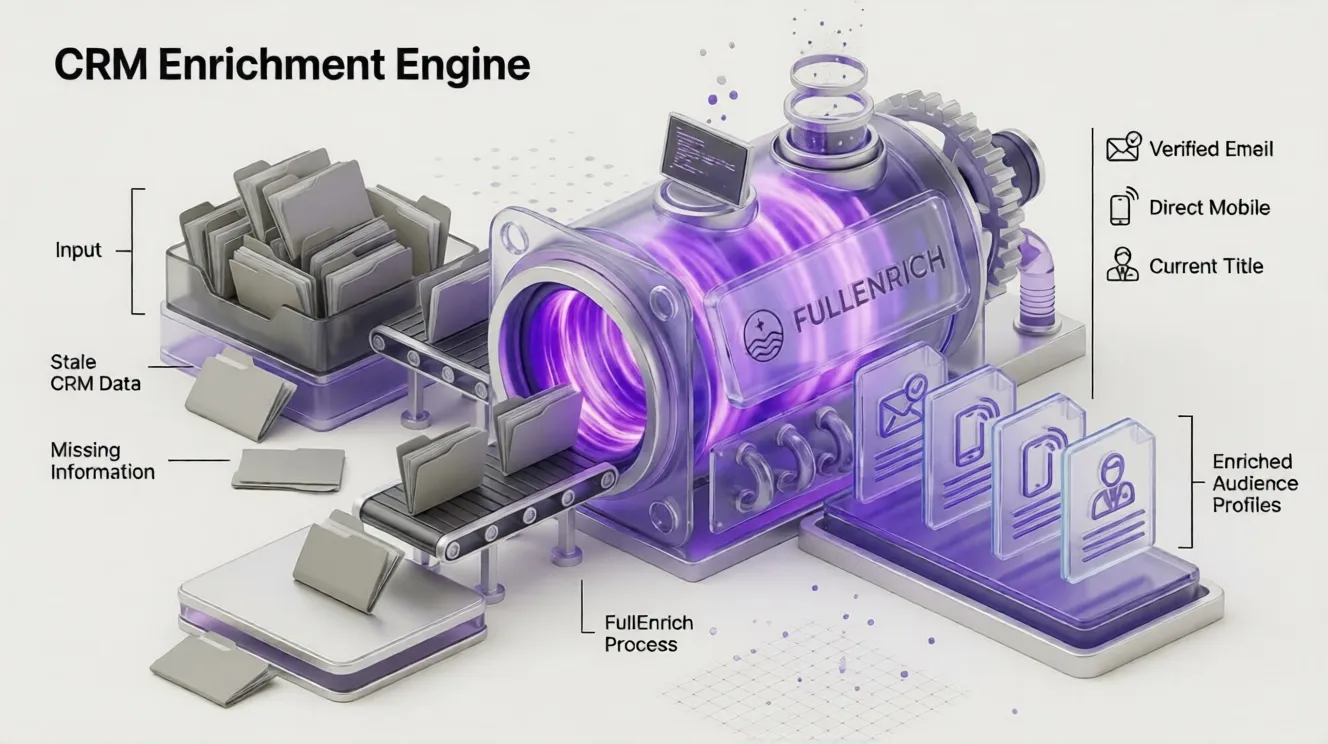

CRM contact enrichment is the process of appending verified, current intelligence to existing contact and account records in a CRM: job titles, direct emails, mobile numbers, firmographic attributes, and technographic data sourced from external providers. The goal is not just to fill empty fields. It is to make every record in the system actually usable.
What is the Need of CRM Contact Enrichment?
A CRM is only as useful as the data inside it. Most are quietly rotting. B2B contact data decays at 22.5% annually, which means a database that was accurate at the start of the year has lost roughly one in four records to job changes, company restructuring, and stale contact details by December.
According to data collected, sales reps waste 546 hours per year chasing bad data. That is more than 13 working weeks per person, lost to dead-end dials and bounced emails.
This connects directly to B2B data enrichment principles and overlaps in function with contact data enrichment, but CRM enrichment has a specific operational scope: it targets the live database that sales, marketing, and RevOps run campaigns, score leads, and route accounts from day to day.
What Does CRM Contact Enrichment Actually Add?
CRM contact enrichment appends four categories of data to existing records. Each category solves a different operational gap, and each decays at its own rate, which is why treating enrichment as a one-time event rather than a continuous process always produces diminishing returns.
Contact-level data covers direct work email, personal email, mobile phone, job title, seniority level, department function, and LinkedIn profile. These are the fields reps use for actual outreach. Job titles change at 65.8% annually. Mobile numbers go stale at 42.9% per year. Email addresses decay at 37.3%. Any of these fields left unverified for two or three quarters is likely wrong.
Firmographic data covers company size, revenue range, industry vertical, growth stage, headquarters location, and org structure. Marketing uses these attributes for segmentation. RevOps uses them for territory assignment and lead scoring models. Sales uses them to understand who they are talking to before the first call. Firmographics decay more slowly than contact data, but company acquisitions, headcount shifts, and rebrands make them unreliable within 12 months without a refresh cycle.
Technographic data reveals the current technology stack: the CRM, marketing automation platform, analytics tools, security infrastructure, and communications software an account runs. This data does not decay as fast as contact details, but it is rarely captured at all in standard CRM records. Without it, reps cannot tailor positioning to the tools a prospect already uses, or identify where a competitive displacement opportunity exists.
Intent signals indicate buying readiness. First-party signals come from website activity, content downloads, and email engagement tracked in the CRM itself. Third-party signals surface accounts actively researching a category across external publisher networks and review platforms. Appending intent data to CRM records transforms static contact lists into a prioritized queue sorted by actual buying behavior.
The Real Cost of Running Enrichment-Starved CRM Records
The 1-10-100 rule, formulated by George Labovitz and Yu Sang Chang in 1992, holds that verifying a data record at the point of entry costs $1, remediating it after problems emerge costs $10, and the cost of doing nothing is $100 per record.
That framework has only gotten more relevant as B2B databases have scaled in size and the pace of contact data decay has accelerated.
The cost surface of stale CRM data is wider than most teams estimate. Gartner puts the average annual loss from poor data quality at $12.9 million per organization.
44% of companies report losing more than 10% of annual revenue directly attributed to inaccurate CRM records. These figures include wasted rep time, failed email campaigns, misrouted leads, and bad forecasting built on records that do not reflect market reality.
The operational drag shows up across every function. Marketing sends campaigns to contacts who changed roles or companies.
Lead scoring models built on stale firmographics route wrong-fit accounts to enterprise sales while mid-market prospects go to SMB queues. SDRs spend the first minutes of every prospecting session manually verifying data before they can dial. None of this is visible in any single metric, which is why organizations often underestimate how much the problem is costing them. 60% of companies do not even track what bad data costs them.
How CRM Contact Enrichment Works?
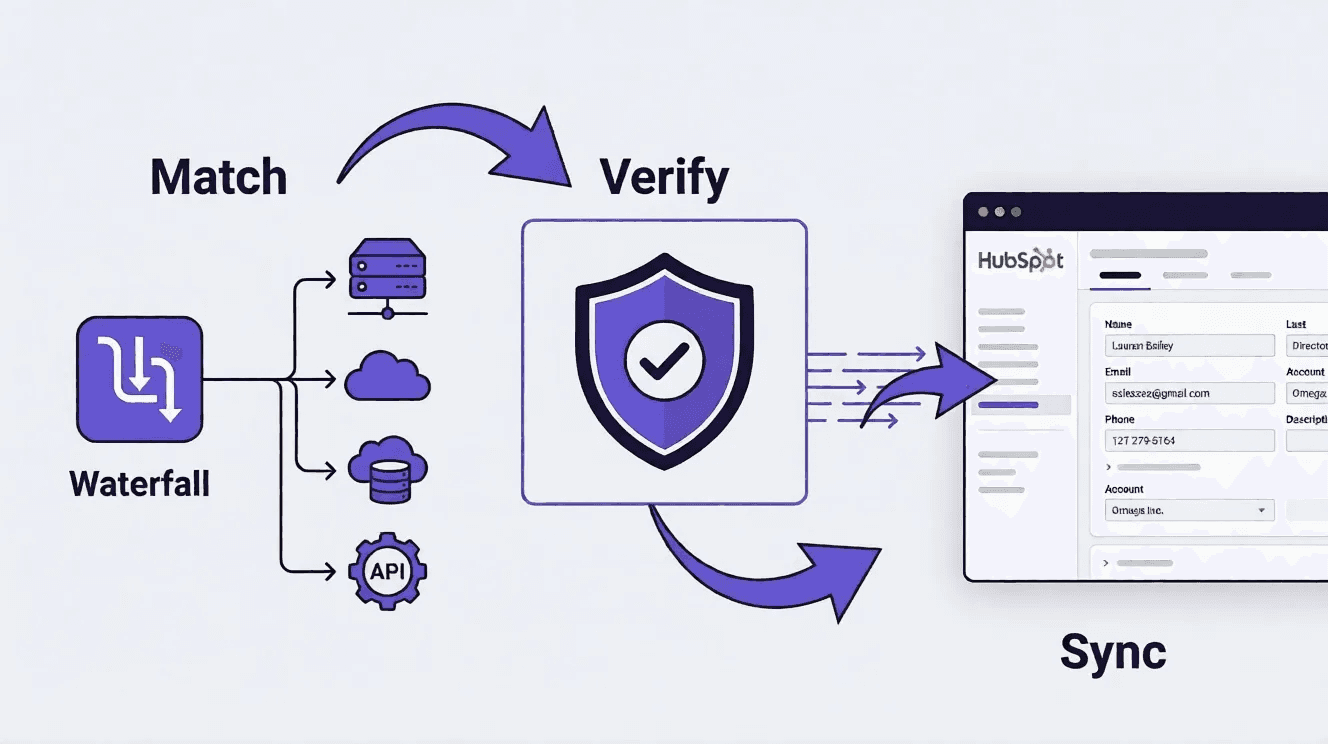
CRM contact enrichment runs through three sequential operations: match, verify, and sync. These are not independent steps that happen in a batch once a year. In modern enrichment systems, they run continuously as records enter, age, and trigger refresh conditions.
1. Matching:
It starts with a unique identifier on each record: a corporate email address, a LinkedIn URL, a company domain, or a combination of name and company name. The enrichment engine queries external databases using that identifier and returns matching attributes. The quality of this match step depends entirely on how many data sources the engine queries. A single provider returns what it has and stops. A waterfall system continues querying sequentially across multiple providers until the record is complete or all sources are exhausted, producing materially higher find rates.
2. Verification
It happens after the match. A returned email address that has not been SMTP-verified may still bounce. A mobile number that was confirmed six months ago may no longer connect. Triple verification, confirming email deliverability through an SMTP handshake, confirming phone connectivity through carrier database checks, and validating job titles against current org structure, is what separates enrichment that produces clean records from enrichment that moves errors from one system to another. Unverified data costs money in bounce penalties, wasted call time, and sender reputation damage.
3. Syncing
Syncing pushes the verified data into the correct CRM fields through API integration. The field mapping logic at this stage determines whether enrichment improves or degrades data quality. Overwrite logic should update only stale or empty fields, and should always protect data that was manually entered and verified by a rep or ops team member. A mobile number a rep confirmed last week should not be overwritten by an enrichment run three days later. The system needs to distinguish between fields that are trusted-current and fields that are candidates for refresh.
Where Enriched CRM Data Changes Outcomes?
The value of CRM contact enrichment is not in having more complete records. It is in what those records enable. Four operational outcomes change meaningfully when the CRM runs on verified, current data.
Lead routing becomes accurate
Firmographic attributes like employee count and annual revenue drive territory and tier assignment in most CRM routing configurations. When those attributes are stale, leads land with the wrong rep, get worked by the wrong sequence, and produce worse conversion outcomes than they would have with correct routing. Enrichment maintains the accuracy of the segmentation inputs that every downstream routing decision depends on.
Personalization scales past surface level
A rep who knows a prospect's current title, the tool stack they run, and the business context of their company can open a call or write an email that connects to the prospect's actual situation. Generic outreach built on empty or stale fields cannot do that. The gap between enriched and unenriched outreach widens as deal size increases, because larger deals involve stakeholders who immediately recognize underprepared sellers. Sales data enrichment and marketing data enrichment workflows both produce better outputs when the underlying CRM records are current.
Champion moves become visible
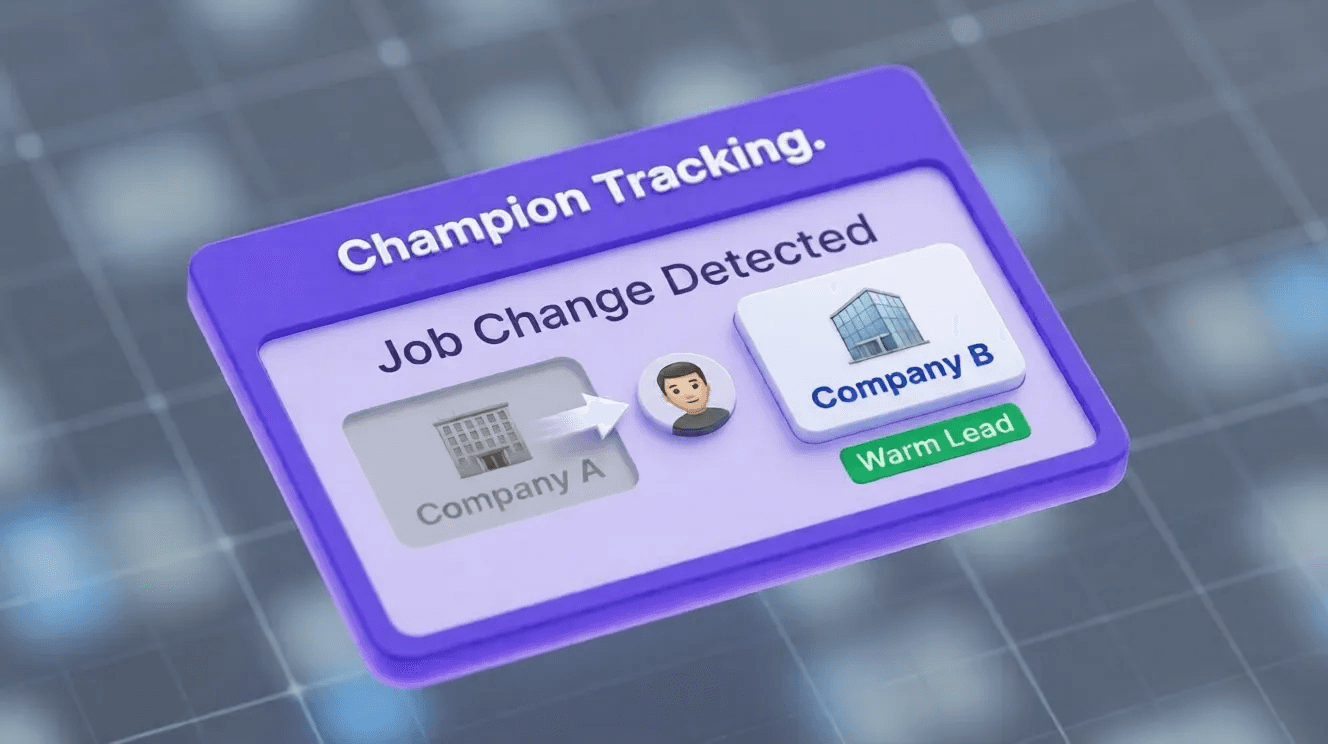
When a contact who was a strong advocate at a previous account changes jobs and moves to a new company, that event creates one of the warmest possible outbound opportunities: a buyer who already knows the product and potentially wants to bring it with them. Without enrichment monitoring contact movement, that signal is invisible. With it, the CRM creates a new high-priority lead automatically.
Lead scoring models stay calibrated
Lead scoring models built on CRM attributes assume those attributes are accurate. When job titles are stale, seniority scores are wrong. When firmographic data is outdated, ICP fit scores are wrong. When intent signals are not appended, timing scores are absent entirely. Enrichment is not an input to lead scoring; it is the precondition for lead scoring that produces results rather than noise.
When to Enrich: Point-of-Capture, Triggered, and Scheduled
Enrichment timing determines which problems it can solve. There are three distinct enrichment moments, each serving a different function, and most organizations benefit from running all three.
Point-of-capture enrichment runs the moment a new record enters the CRM, whether through a form submission, a manual import, a CSV upload, or an API event. This is the $1 moment from the 1-10-100 rule. Catching a bad email address, a missing title, or an incomplete company record before it propagates into active campaigns, sequences, and scoring models is significantly cheaper than remediation after the fact. Point-of-capture enrichment also enables real-time lead routing: a form submission that arrives with only a name and work email can be enriched, scored, and routed to the correct rep within seconds, while the prospect's attention is still on the page.
Event-triggered enrichment fires on specific CRM conditions: when a contact reaches a threshold engagement score, when an account shows intent signals, when a deal enters a new pipeline stage, or when a rep manually flags a record for prep before an outbound sequence. This is how real-time data enrichment integrates into CRM workflows: not as a scheduled job, but as a response to signals that indicate a record needs to be current right now.
Scheduled bulk refresh addresses existing database hygiene for the full record set. Given contact decay rates, active target accounts should be refreshed every 60 to 90 days. Dormant records can run on a quarterly cycle. This sweep catches the contacts that slipped through without point-of-capture enrichment, updates firmographic data that has shifted since the record was created, and surfaces champion move opportunities across the entire database at once.
CRM Enrichment for RevOps: Integration and Field Mapping
For RevOps teams managing CRM architecture, enrichment introduces two infrastructure concerns that determine whether the program produces value or creates noise: integration design and field mapping logic.
Integration design governs the data flow between enrichment provider and CRM. Native API connections are preferable to CSV-based imports because they enable real-time and event-triggered enrichment rather than forcing batch-only workflows. Most major enrichment platforms offer direct integrations with Salesforce, HubSpot, and Pipedrive. The connection should be bidirectional where possible: enrichment pushes verified data into the CRM, and CRM events trigger enrichment requests. Bidirectional flow enables the event-triggered patterns described above.
Field mapping logic controls which enriched attributes land in which CRM fields and under what conditions. Three rules produce the cleanest outcomes. First, enrich blank fields automatically. Second, overwrite stale-likely fields (title, company headcount, department function) on a scheduled cadence. Third, protect manually verified fields from automated overwrite. A good mapping configuration also separates enriched data from original data where both exist, for example routing enriched email to a "Verified Direct Email" field while leaving the original form-submitted email in its own field, so both are accessible and neither overwrites the other.
RevOps teams often underestimate how much of their lead scoring model's inaccuracy traces back to stale CRM inputs rather than model design. Before reconfiguring scoring logic, audit the enrichment coverage of the attributes the model relies on. More often than not, the model is correct but the data feeding it is not.
How FullEnrich Handles CRM Contact Enrichment?
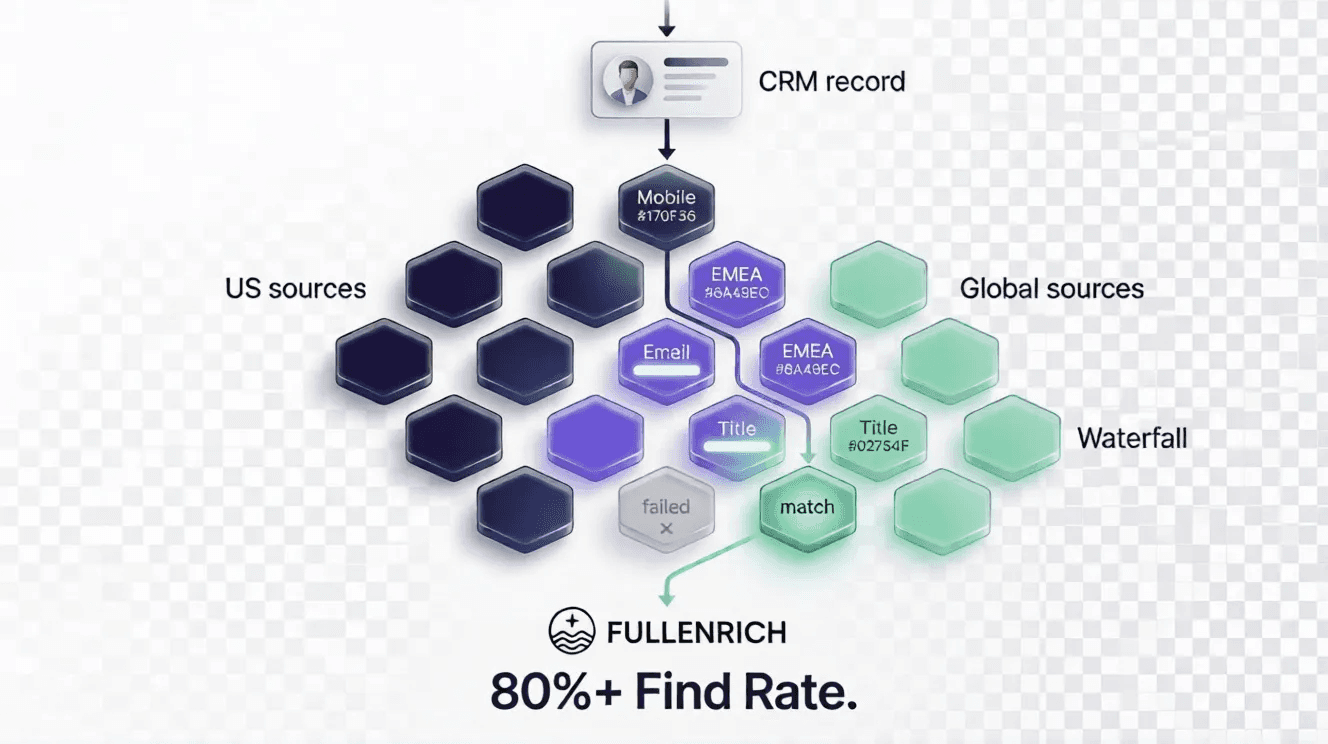
CRM databases contain accounts across different geographies, industries, and company sizes. The coverage gaps that exist in any single data provider's database become visible at scale: records from EMEA accounts, small companies, or industries underrepresented in major US-centric databases come back incomplete.
This is where single-source enrichment consistently underperforms.
FullEnrich runs a waterfall across 20+ data providers, querying sequentially until each record is either fully enriched or all sources have been tried. Where a single provider returns 40 to 60% match rates, the waterfall approach reaches an 80%+ find rate, with regional routing that directs EMEA accounts to providers with the strongest European coverage and US accounts to US-first databases.
For CRM programs enriching large, geographically distributed contact lists, that difference in match rate is the difference between a useful program and one that leaves most of the database untouched.
The credit model matters for CRM enrichment specifically. FullEnrich charges only for successful enrichment that passes triple verification: SMTP email validation, carrier phone connectivity, and job title accuracy.
Failed lookups cost nothing. For bulk refresh programs working through databases with varying levels of decay, this model eliminates the waste that comes from paying for every lookup attempt regardless of outcome.
Start enriching your CRM with FullEnrich
Conclusion
CRM contact enrichment is not a data quality project. It is a revenue operations function. The records that routing logic, lead scoring, personalization, and forecasting depend on need to be current for any of those systems to work as designed.
Decay makes them unreliable within months of creation, and the cost of that unreliability compounds across every campaign, sequence, and pipeline review that runs on stale data.
Point-of-capture enrichment, event-triggered updates, and scheduled bulk refresh together keep the database from accumulating the debt that shows up as wasted rep time, bad leads, and missed champion moves. Waterfall enrichment across 20+ providers closes the coverage gaps that leave geographic and segment blind spots in single-source programs.
Frequently Asked Questions
What is CRM contact enrichment?
CRM contact enrichment is the process of appending verified external data to CRM records: contact details, firmographics, technographics, and intent signals. It keeps existing records current as contacts change roles, companies evolve, and buying signals emerge, ensuring that sales, marketing, and RevOps operate from accurate intelligence rather than decayed records.
How is CRM contact enrichment different from contact data enrichment?
Contact data enrichment refers broadly to enriching individual contact records with missing attributes. CRM contact enrichment specifically addresses the operational database that teams use daily, including the field mapping logic, workflow triggers, integration architecture, and refresh scheduling required to keep a live CRM current at scale. The scope is wider.
How often should CRM data be refreshed?
Active target accounts benefit from re-enrichment every 60 to 90 days given the pace of contact-level data decay. High-priority accounts showing active engagement signals should be refreshed more frequently, ideally triggered by CRM events rather than scheduled intervals. Dormant records can run on a quarterly cycle. Point-of-capture enrichment at record creation handles the entry point independently.
What happens when enriched data conflicts with existing CRM data?
Field mapping logic determines the outcome. Best practice is to auto-fill blank fields, overwrite fields likely to have decayed (job title, headcount, department), and protect fields a rep has manually verified. Separate field pairs (original email and verified direct email, for example) preserve both values without forcing one to overwrite the other.
Does CRM enrichment help with ABM programs?
Yes. ABM data enrichment draws on the same underlying data types as CRM contact enrichment. When the CRM already holds verified firmographic, technographic, and contact data for target accounts, launching an ABM motion requires less pre-campaign enrichment work and produces better segmentation, routing, and personalization from the start.
What is champion tracking in CRM enrichment?
Champion tracking monitors contact records for job changes. When a contact who was a strong product advocate moves to a new company, the enrichment system updates their record with the new employer and flags the event for sales. It converts a routine data update into a high-priority warm outbound opportunity.



Other Articles
Cost Per Opportunity (CPO): A Comprehensive Guide for Businesses
Discover how Cost Per Opportunity (CPO) acts as a key performance indicator in business strategy, offering insights into marketing and sales effectiveness.
Cost Per Sale Uncovered: Efficiency, Calculation, and Optimization in Digital Advertising
Explore Cost Per Sale (CPS) in digital advertising, its calculation and optimization for efficient ad strategies and increased profitability.
Customer Segmentation: Essential Guide for Effective Business Strategies
Discover how Customer Segmentation can drive your business strategy. Learn key concepts, benefits, and practical application tips.